 TYPICAL
The Holiday Issue · His side here. Her side: The costume double standard at Typical Female.Pick a side ↓
Here's the uncomfortable math of every adult Halloween party: the men get rated on effort, and the women get rated on themselves.
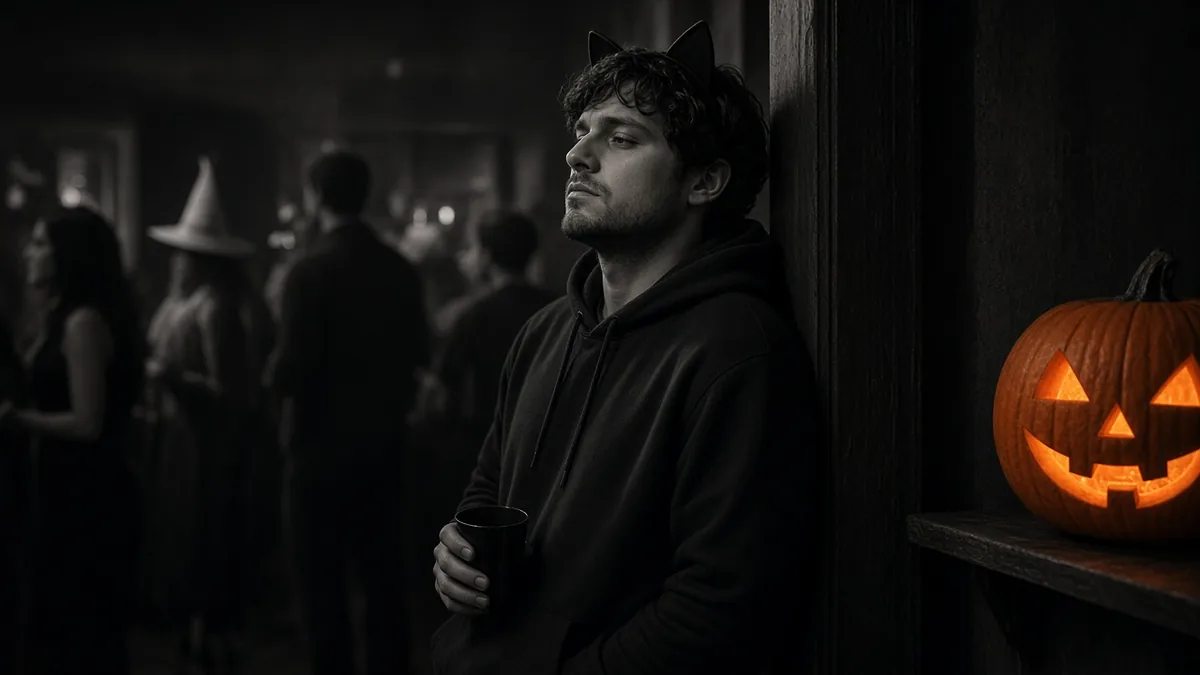
Two Halloweens ago I went to a party as "a guy who forgot it was Halloween." The costume was a cardboard sign that said exactly that. I got three laughs and a beer.
My partner went as a witch: black dress, hat, a little more eyeliner than usual. Before we'd been there an hour, she'd heard two comments about it. One was meant as a compliment. One wasn't. Neither was about the costume, really. They were about her.
Nobody asked what my cardboard sign said about me. It said plenty, honestly. It said I couldn't be bothered. But on a man, not being bothered reads as a personality. On her, every choice reads as a statement.
My costume was a cardboard sign. Hers was a referendum.
The most popular costume gets the most commentary
Here's the thing that got me. The witch is not a fringe choice. The National Retail Federation's 2026 survey projects about 4.8 million adults will dress as a witch, making it the single most popular adult costume in the country. Adult costumes are about a $2 billion market on their own. My partner picked the most normal costume in America and still got graded on it.
I'm not going to pretend I invented this observation. Women have been saying it for years: shorter is "asking for it," longer is "no fun," funny is "trying too hard," scary is "not cute." There's no costume that exits the conversation. Meanwhile men get to be a ghost, a vampire or a sign.
The other side: "It's just a party"
I've heard the counterargument, and I've made it. Halloween is a night built on exaggeration. People dress to provoke, to be noticed, to get a reaction, and some reaction is part of the deal. Men get teased too: the guy whose costume is too try-hard, the guy in borrowed scrubs. A joke about a costume isn't a crime, and a party where nobody can say anything isn't a party.
All true, up to a point. The point is where the comment stops being about the costume and starts being about her body, her age, her motives. That line isn't hard to find. Most of us just never look for it, because we're never the ones standing on the other side of it.
What it sounds like from the next spot over
The "compliment." "Wow, didn't know you had that in you." It sounds friendly. What it says: I've been evaluating you, and you surprised me.
The cover-up comment. She goes as a full-length witch, and someone says, "Aw, playing it safe this year?" Too little counts as a failure too.
The partner check. Someone turns to me, not to her: "You let her out like that?" As if her costume were a permit I'd signed. Until I wrote these down, I hadn't noticed that I've never heard one of them said about a man.
What I was doing wrong
I didn't make either of the comments. But I laughed at the first one, the "compliment," because it was easier than making it a thing at someone else's party. That's the part I keep turning over. The double standard doesn't need men to run it. It just needs us to stand there.
The double standard doesn't need men to run it. It just needs us to stand there.
What I do now
Three small rules, none of them heroic. If someone comments on her body under cover of commenting on her costume, I don't laugh. I don't have to make a speech; not laughing is louder than you'd think. If I'm hosting, I say it plainly once: costumes are fair game for jokes, bodies aren't. And I ask her before the party, not after, how she wants me to handle it if it happens. Sometimes the answer is "ignore it." That's her call, not mine.
The test I use now
Before I comment on anyone's costume, mine included, I ask one question: would I say this to a guy dressed as the male version? If the answer is no, the comment isn't about the costume.
This year I'm going as a vampire, finally putting in some effort. She's going as whatever she wants.
Her side of the double standard, from the women who actually wear the costumes, is at Typical Female: The costume double standard.
Frequently asked questions
What is the Halloween costume double standard?
It's the pattern where women's costumes get read as statements about their character, too revealing or too covered up, while men's costumes are mostly judged on effort, if they're judged at all.
What are the most popular adult Halloween costumes this year?
According to the National Retail Federation’s 2026 survey, witch leads (about 4.8 million adults), followed by vampire, Batman, Spider-Man and ghost.
How should a man respond if someone comments on his partner's costume?
Don't laugh along. If it's about her body, a flat "Not cool" or a change of subject is enough. And never answer a question about her costume that should be asked to her.
Is it okay to joke about someone's Halloween costume?
Jokes about the costume, yes; that's what costumes are for. Jokes about the person's body or motives, no. A quick test: would you say it to a man in the equivalent costume?
Your turn
Is it fair game to judge a costume, or does the judging always land harder on women? Pick a side below, then tell us the comment you still remember.
Pick a side
Should anyone get judged for a Halloween costume?
Tap one to get your share card. Your pick stays on this device; it is not a vote tally.
I took a side
The card links back to this piece. It is not a vote tally.
 Her side · Typical FemaleThe costume double standardRead her take ↗
- Take the quiz: How typical is your Thanksgiving?
- Add your take to the Debate of the Month: Whose family gets Thanksgiving?
- Tell us your story. 18+, anonymous if you want, read by an editor.
More from the Holiday Issue
Sources
- National Retail Federation, Halloween 2026 consumer survey (Prosper Insights, n=7,889, Sept 1–9, 2026). About $2 billion of 2026 costume spending is expected to go to adult costumes; witch is the most popular adult costume, with about 4.8 million people planning to dress as one.
- National Retail Federation, "Top Halloween costume trends for 2026". Costume preferences split by gender and generation in NRF's 2026 trend data.