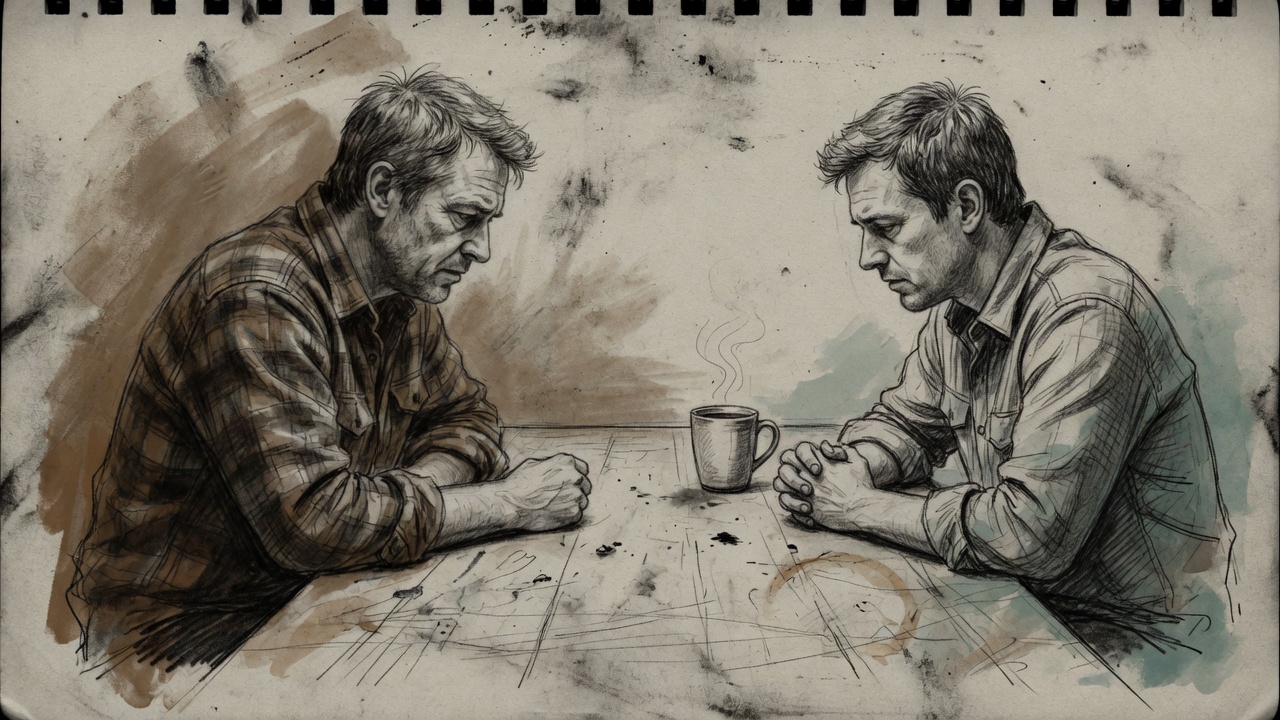
My father grew up in a house where the loudest sound was the radiator. I grew up in a house where the loudest sound was my father not saying anything. My son is growing up in a house where the loudest sound, on most days, is me.
I am told this is progress. I am not always sure.
What gets handed down between fathers and sons is not always handed down in words. Often it is handed down in the absence of words. The pause that goes too long. The eyes that look at the dish in the sink instead of at the kid asking the question. The body language that says, this conversation is over before you started it. My father never sat me down and said, boys do not feel this way. He just left the room when I cried, every time, until I learned not to cry in rooms that contained him. Which, in a small house, was every room.
I want to be careful here. My father was not a cruel man. He was a quiet man, raised by quieter men, who came back from a war he did not talk about and went to work at a job he did not enjoy and did not complain about, because complaining was something he had been told, somewhere along the way, was a thing other people did. He provided. He showed up. He was present in the way that a coat tree is present — reliably, in the corner, holding things you needed it to hold. I loved him. He loved me. We did not, between us, accumulate more than maybe forty hours of conversation across forty-one years.
I noticed the inheritance the way most men do. Late, by accident, and through the eyes of someone who could not have known what they were noticing.
My son is nine. A few months ago he came home from school in the kind of mood that, in my house growing up, would have been left alone. He is the kind of kid who does not cry easily. When he cries, something has happened. He went straight to his room. He shut the door. He did not slam it, which was somehow worse.
I knocked. He said, I'm fine.
I knew that I'm fine. I had said that I'm fine. I had been told that I'm fine by my father — the wide-shouldered I'm fine that means do not come in here — for forty-one years. I knew the rules of that I'm fine. The first rule is that you let it close the door. The second rule is that you say something casual through the door and walk away. The third rule is that you both pretend the conversation didn't happen, and then dinner is dinner, and the world resumes its normal shape. I knew the rules because I had been issued the rules at the same age, in a similar bedroom, by a man who had been issued the rules by his own father in 1958.
I stood at the door. And I felt, in my body, the inheritance. It moved through me like a current through copper. Walk away. Give him space. He'll come down for dinner. Don't make it a thing. Every cell I had been built from was telling me to obey the rules.
I knocked again. I said, buddy, you don't have to be fine. I'm coming in.
And I went in. And he cried. And I cried. And we sat on the floor of his Lego-dusted bedroom for forty minutes while he told me about a kid at school who said something cruel about his teeth, and the cruel thing didn't matter, and the cruel thing absolutely mattered, and the air got smaller in the room, and then bigger, and then we went down for dinner.
I am writing this because I want to be honest about what came after.
What came after was not relief. What came after was a strange, raw exhaustion, and underneath the exhaustion was something I could only name later as a longing for something that may have never existed. I was not exhausted from comforting my son. He was, in fact, easy to comfort. I was exhausted from disobeying my father. I was exhausted from the muscle work of breaking a current that had been running through generations of men in my family before electricity was even invented. I was exhausted from grieving — and this is the part I did not expect — for the small boy I had been, behind a door, who had not been knocked on.
This is the thing nobody warned me about. You cannot give your kid the conversation you didn't get without, in real time, mourning the conversation you didn't get. The two arrive together. They are the same conversation, viewed from opposite ends.
For weeks afterward I noticed I was withdrawing in small ways. Not from my son — I was overcompensating in his direction. I was withdrawing from my wife, from my friends, from my body. I was sleeping more. I was numb in the late afternoon. Emotional numbness is, my therapist tells me, almost always a tax on a system that just did expensive work. I was running a deficit because I had spent something I had been hoarding for forty years.
I tell my friends about that night now. About knocking twice. About the door. Most of them go quiet for a beat and then start telling me about their fathers. Not their kids. Their fathers. Almost every man my age, when handed the word inheritance, immediately turns around and looks backward.
I think we need to look both ways at once. The man who raised you is part of the answer. The kid you are raising is the other part. They sit at opposite ends of the same room. The work is not in either chair. The work is the walking back and forth, with full hands.
What I want to say, if I can say it cleanly:
The silence I was handed was not malice. It was a survival strategy that had outlived the threat it was built to survive. Men in my family had been quiet because quiet had, somewhere upstream — a war, a depression, a steel mill closing — kept them alive. The strategy got fossilized into character. The character got passed forward. By the time it reached my father, the threat was gone, but the silence remained. By the time it reached me, the silence was so thoroughly mine I did not even recognize it as inheritance. I thought it was personality.
It was not personality. It was a coat I had been issued at birth, three sizes too big, and I had grown into it.
I am trying to take it off in front of my son. I am not trying to throw it away. There are uses for silence. The silence at a sickbed. The silence on a hike. The silence of a man who knows when to listen and not interrupt. Some inheritance is wisdom. Some is just dust. The work is sorting.
What I can tell my son — not in a sit-down talk, but in the dailyness of being his father — is something my father could not have told me, because nobody had told him: the door is not the rule. The door can be knocked on. The door can be opened. The conversation can happen on the floor in a bedroom. The conversation will not kill you. It will, in fact, save you, several times, across the long arc of being a man.
This is what I am trying to hand forward.
I am, at the same time, trying to walk back to the closed door I stood in front of when I was nine. There is no man behind it anymore. He died last year. But standing in the empty hallway of the house I grew up in, I can still knock. Not to be answered. Just to be the kind of grown man who, given the chance again, would knock twice. The boy behind the door, in 1990, in a small Pennsylvania town, hears the knock now. I know that doesn't make literal sense. It makes another kind of sense.
If you are a father reading this, and you have been wondering whether to knock on a door tonight: knock. Knock twice. Then go in. The exhaustion that follows is not failure. It is the muscle of a chain breaking.
If you are not a father, and you are reading this, and you are thinking about the doors in your own childhood: I am sorry. I am sorry no one came in. I would have. I'm late. I'm here.
If you're trying to start a conversation like this with your own father, our scripts for talking to your dad about depression may help. If you're trying to read what your son's silence actually means, the translate-his-silence tool walks you through plausible interpretations. And if you're a new dad and reading this in the middle of everything: the resources for new fathers page.