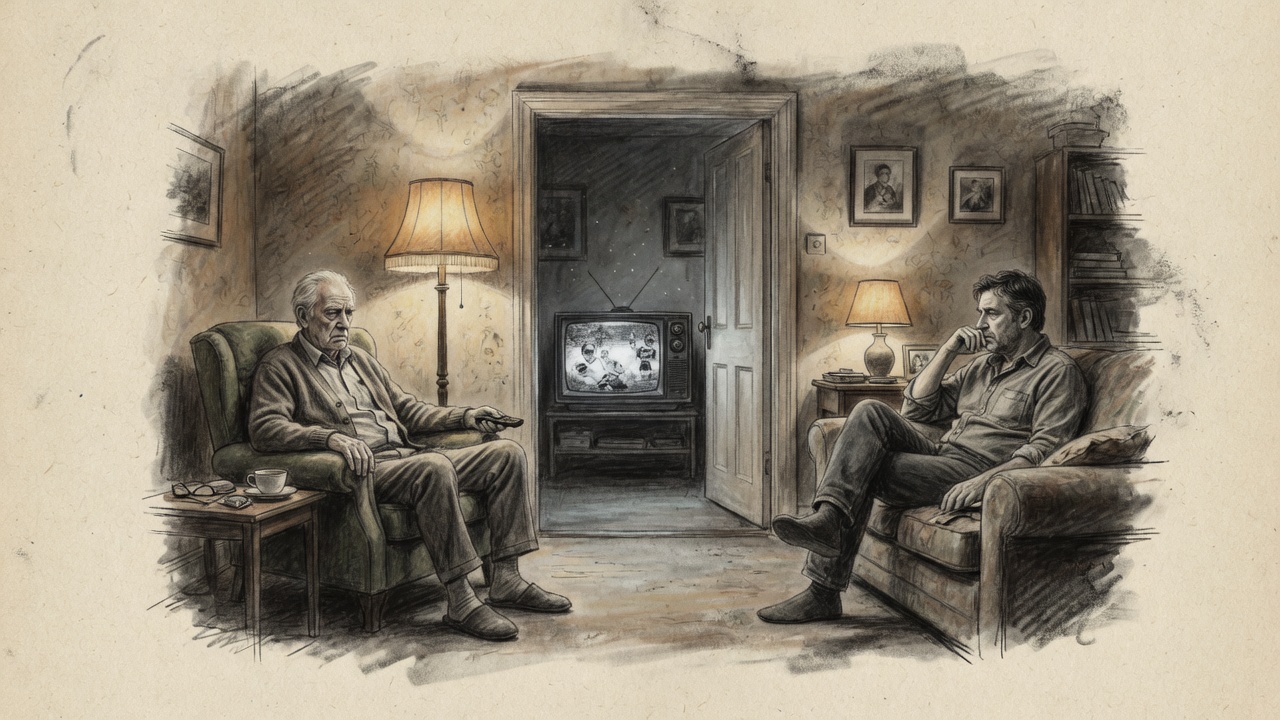
My father did not say I love you to me until I was twenty-eight years old.
It was a Tuesday. He had just been diagnosed with the cancer that would, two years later, take him. We were sitting in the parking lot of an Olive Garden in Albuquerque. He was eating a breadstick. He said it the way men of his generation say important things — like he was returning a borrowed wrench. You know I love you, right. Not a question. A confirmation that the wrench had been on the workbench all along, and we both knew it, and now I was being officially handed the wrench so we could move on.
I cried in the car after he went inside. I have a son now. He is six. I told him I loved him this morning over cereal. He said it back without looking up. Cheerios in his teeth. He is being raised inside a sentence I did not have growing up.
This is the project of this magazine, distilled to one breakfast.
The first issue of Typical Male is about inheritance. Not the kind that arrives in a will. The other kind. The slow drip of what gets handed down without a ceremony. The shape of how a man holds his shoulders. The list of feelings he was told were not for him. The silence around the kitchen table that becomes a silence around your own kitchen table thirty years later, and you cannot remember when you decided to be quiet that way, because nobody decided. It was inhaled.
What gets handed down most often is what nobody knew they were handing.
The dozen pieces in this issue look at that handover from every angle we could find. A man writes to himself about his father's silence and the way it has migrated into the way he listens to his own son. A wife describes reading her husband's father into him, the inherited mannerisms that arrive in her bedroom uninvited. A reporter spends twelve weeks inside a fathers' group, sitting with men who are trying to put down the thing they were given. A clergyman argues that "breaking the cycle" is the wrong metaphor. A clinician says therapy has been imprecise about what father wounds even are.
And four short Raw pieces in the back: a list of things one man's dad never said to him, a wife's things she has finally told her husband about his father, a eulogy for a still-living father, and the piece I think about most: a son writing about the anger he was handed, and how he is trying not to hand it forward.
None of them are tidy. The cycle is not a cycle. It is a soft re-wearing.
I'll tell you what I keep returning to as I edit these pieces. It is not the question how do I undo what was done to me. That question is a trap, because most of what was done to us was not done; it was simply not said. You cannot un-not-say a thing.
The question I keep returning to is the smaller one: what specific sentence did my father not say to me, and am I willing to say it to my son this week.
Then: what feeling did my father not have permission to feel, and am I willing to feel it on his behalf, in front of my kids, this Saturday.
Then: what is the one thing I am still carrying for him that I am ready, today, to hand back.
You can't fix the man who raised you. He is who he is. Often by the time we have the language for what was missing, he is already gone, or about to be gone, or unreachable through dementia, or distance, or his own deep refusal. The work is not at his feet. The work is at our own feet, and at our children's. The handing forward.
This issue is dedicated to the men we did not get to be raised by, because they were never given permission to become themselves.
And to the men we have permission to become.
—
If something in this issue stirs something heavy, our crisis resources page lists every line we trust, including 988 for immediate help. If you are sitting with the slow weight of anticipatory grief for a parent who is still here, our grief timeline tool helps you map what's coming. If you want to write through any of this, the journal prompts tool has 200+ context-aware prompts. We built these because we needed them. We hope you do too.
Enjoy the issue. Or sit with it. Both work.
— David Shadrake
Founding Editor, Typical Male
May 2026