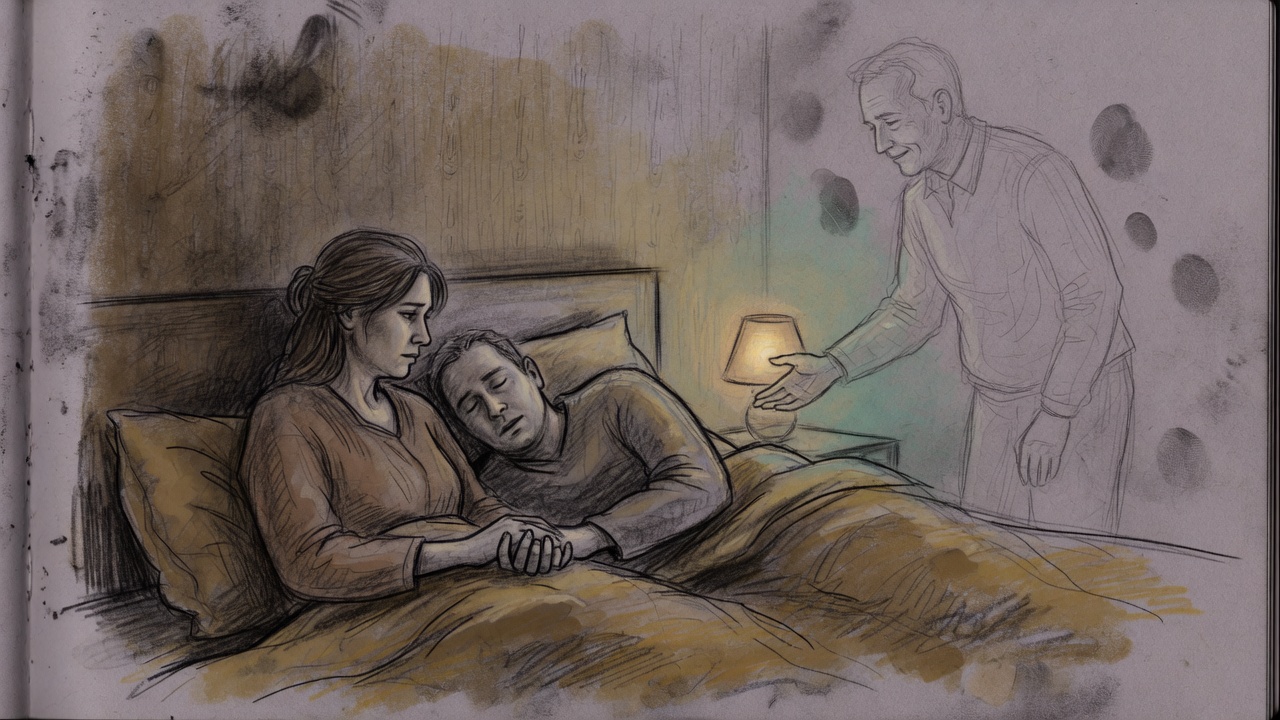
I met my husband's father exactly four times before he died. Each time was a holiday. He sat at the head of a table he had carved himself out of a piece of New Hampshire oak. He did not say much. He nodded. He passed dishes. He said things like that's good and I'm full and, once, after a long political argument with my husband's brother in the kitchen, that's enough now. He died in February, which is the only month an old man should die in New England, because everyone is already braced.
I thought I had escaped him by marrying his son.
I was wrong. I had married him. I just did not yet know how to read it.
The first time I noticed the inheritance was in a fight about a bathmat.
This sounds like a joke. It is not. We had been married for four years. The fight was not really about the bathmat. The fight was about the way my husband had — for the third or fourth time that month — withdrawn into a place I could not follow him to. The bathmat was the precipitating offense, in the way an argument between people who love each other is always about a bathmat.
What I said: can we talk about this.
What he said: I'm fine.
What he did, immediately after: he turned and walked into the garage. Not slammed the door. Not anything dramatic. Just turned and walked. The way a tide goes out. With the same lack of explanation.
I stood in our hallway. And in my mind, with absolute clarity, I saw my father-in-law at the head of the New Hampshire table, eight years earlier, after his older son had said something cutting. I saw him not respond. I saw him look at his plate. I saw him push back from the table and stand and walk toward the back door and put on his coat and go out to split wood, in February, in the dark, for an hour. I had thought, at the time, that's a sad man. I had not thought, that's a sad gesture being recorded by my future husband, who is twenty-two and hasn't fully decided yet, but is paying close attention.
The estate of unsaid things had been transferred. I just hadn't been at the reading of the will.
I want to be careful here, because I love my husband, and I do not want to write a piece that flattens him into his father. He is not his father. He is funnier, softer, more verbal, more available, more curious, more alive in the body than his father was on his best day. The father was a sealed envelope. My husband is a letter that has been opened, and read, and then thoughtfully refolded with most of the contents intact.
But there are gestures.
There is the way he holds a coffee mug in both hands when he is thinking. His father did that. His father did that, and now he does that, and our son — three years old — does it, in miniature, with his sippy cup. Three generations of men holding a warm thing close to the chest, like a question they cannot put down.
There is the way he goes quiet at a stoplight. Not the everyday quiet. A particular quiet, where the jaw sets and the eyes go middle-distance and you can see he has gone into a room you are not invited into. His mother once told me, drinking tea in her kitchen, three months after his father died: oh, your father did that too. He'd go in there for hours sometimes. You could be sitting right next to him and he was a thousand miles away.
There is the way he flinches when our son cries hard. Not turns away — he is a good father, present and attentive — but a microscopic, almost invisible flinch in the chest, before he leans in to comfort. Like a bird that hesitates before landing on a branch it has been told is unsafe. I have asked him about it. He cannot describe the flinch. He says he doesn't experience it. I believe him. That is part of the inheritance: the gestures that arrive without conscious receipt.
I am not the first wife to notice these things. Ambiguous loss is a clinical term for grieving someone who is still alive, and I think the wives of men who carry their fathers in their bodies are doing a kind of small daily ambiguous loss — for the man we know is still in there, somewhere underneath the gesture he didn't choose. I do not want to overstate this. I am not heroically married. I am just married, and paying attention.
For a while I tried to fight the inheritance directly. I would say things like that's your father talking. This is, for the record, the worst thing you can say to a man trying to figure out his own father. It collapses him into someone he is trying, in slow daily increments, to differentiate himself from. It tells him the differentiation has failed before he can finish it. He gets defensive, which makes him more like his father, which proves my point, which makes him more defensive. The hallway gets longer. The garage gets used.
I had to learn a different sentence. The sentence I learned from a couples therapist who, looking back, mostly earned her fee in this one half-hour:
I notice you went somewhere just now. I'm not asking you to come back yet. I just want you to know I noticed, and the door is open whenever.
That sentence does three things. It names the gesture without weaponizing it. It does not demand that he immediately re-enter the conversation. And it makes clear that I am still standing in the kitchen, available, when he is ready to come back from wherever he went. My father-in-law's wife — my mother-in-law, a woman I love — never had this sentence. She had, instead, a tightening of the mouth and a chopping of vegetables. She had, in other words, the wife's version of the same inheritance: a learned silence that mirrored his.
I thought my job was to break him out of his father's silence.
That was wrong. My job was to not become the silence that married it.
What we have, on the good days, is a marriage where his inheritance has become something we can name in the third person. We will be in a restaurant, and his shoulders will do the thing his father's shoulders did, and he will catch it himself, and he will say, with a small grin, oh, there's Howard. (His father's name was Howard.) Howard arrives. We acknowledge Howard. We let Howard sit at the table with us for a minute. Then Howard goes back to wherever he goes, and my husband — my actual husband, who chose me, who is not his father — comes back into focus.
This is what I think the work of inheritance looks like, when it works. Not exorcism. Cohabitation, with naming.
The unsaid things in his father's estate are not contraband. They are heirlooms. Some of them are wisdom — his father's relentless, undramatic loyalty, the way he showed up at my husband's college graduation in a suit that did not fit him, four hours each way, and said almost nothing, and was clearly the proudest man in the room. That heirloom we keep. The other heirloom — the going into the garage, the I'm fine, the that's enough now — we examine, when it appears, and ask whether to keep it.
Some of it we keep. Some of it we hand back.
I cannot hand it back to Howard, who is dead. But I can hand it back to the moment in the New Hampshire kitchen when he was twelve, and his father — who I never met — taught him, in some small unsaid way, that men fold their grief into wood-chopping. That little boy is reachable, in a strange way, through my husband's body. Some nights, when my husband is being more available than he was raised to be — when he comes back from the garage faster than his father would have — I imagine that small boy in 1962, somewhere in him, getting a delayed warmth he never received from his actual father.
That sounds mystical. I'm not mystical. It just describes what the work feels like from inside the marriage.
If you are reading this, and you are married to a man who carries his father in his shoulders, here is what I learned, in case it's useful:
You cannot exorcise his father. His father, if he is dead, is in the bones. If he is alive and absent, he is in the bones. If he is alive and present, he is in the bones. There is no removing him. There is only learning to recognize him when he sits down at your table.
You can learn the sentence I notice you went somewhere just now. It is a better sentence than that's your father talking. It is one of the most useful sentences I know.
You can let your husband decide, in his own time, what to keep from his father and what to hand back. You are not the editor of that estate. You are the witness.
And, if you have small children, you can be the third generation in the room — the one who quietly notices when Howard sits down, and gives Howard tea, and lets your husband come back when he is ready. The kids are watching. The kids are also being handed something. By you, by him, by the way the two of you handle Howard at the table.
What we hand forward, when we are paying attention, is not the silence. It is the noticing of the silence. It is the sentence that opens it. It is the willingness to say, oh, there's Howard, and to laugh a little, and to keep eating.
The estate of unsaid things does not have to be transferred whole. It can be probated. It can be sorted. The unsaid can become the said. Not all of it, all at once. Just one sentence, on a Tuesday, in a hallway, while the bathmat sits on the floor.
If you're navigating this in your own marriage, the "when he says I'm fine" reactive walkthrough was written for exactly the moment described above, and the when he disappears during fights response covers the garage. If you want help reading the gestures: the translate-his-silence tool.