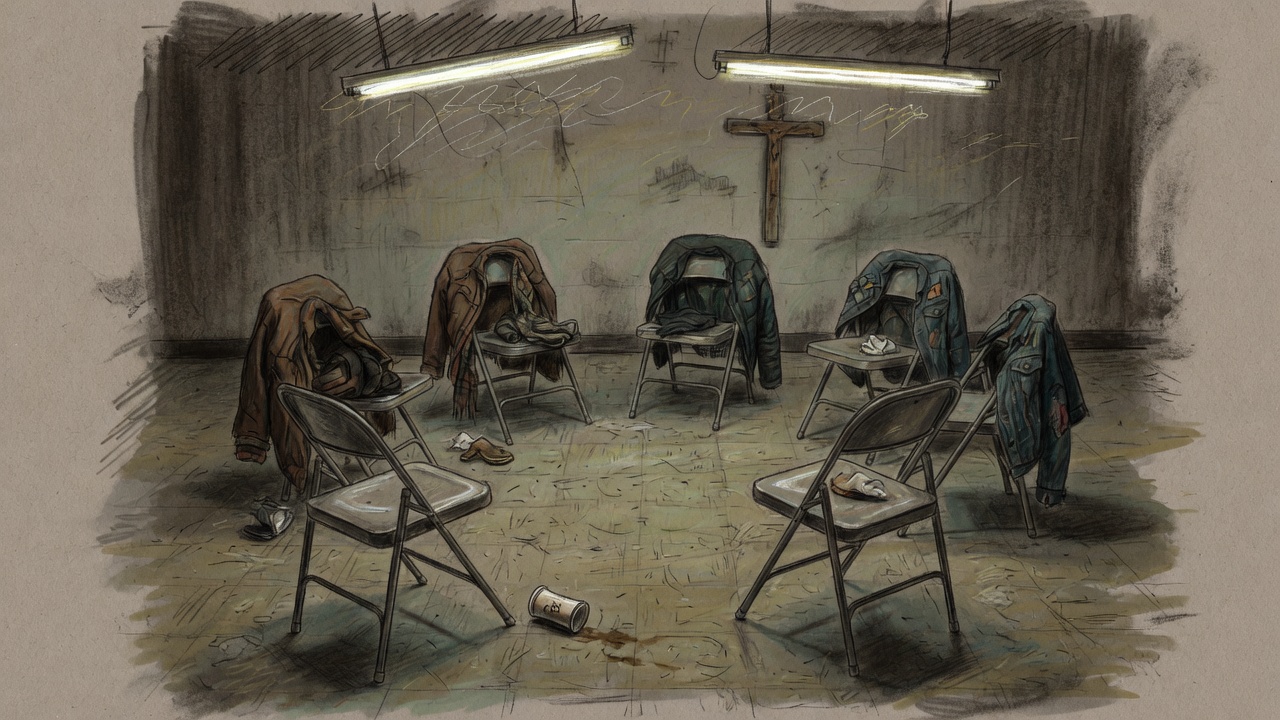
The first night, the room had eleven men in it and zero eye contact.
It was a basement room in a rented church annex on the South Side of Pittsburgh, October, the smell of folding chairs and the faint chlorine of the daycare that used the space on weekday mornings. The facilitator was a man named Dale, sixties, soft-bellied, gray ponytail, retired social worker, who began by saying we were going to introduce ourselves with our first name and one sentence about our father. I had been told beforehand that I could observe and take notes and use first names with permission. I introduced myself as a journalist. The men nodded. Nobody objected. Dale started.
I'm Dale. My father told me I was useless on a regular basis until he died, when I was thirty-one, and I have been trying to find a different way to talk to my own son ever since.
The room exhaled. Some of the men laughed. The kind of laugh that is not really a laugh.
What followed, over twelve weeks, were ninety-six other sentences. I will, with permission, quote a few of them.
My father gave me one piece of advice. He said never let anyone see you sweat. He said it at my college graduation. We never spoke about anything important again.
My father had a stroke when I was eleven, and after that he could only say four phrases. They were: yes, no, dammit, and son. He died at sixteen. I'm forty-two. I miss him every day. I have, mathematically, more memories of him saying my name than memories of him saying anything else.
My father's last text to me was about whether I'd seen the football score. Eight hours later he was dead. I keep that text on my phone. I read it sometimes. It is the only sentence he ever sent me that I am sure he meant.
I never met my father. My mother says he was a good man who loved her. I don't know if I believe her or not. Either way I have spent forty years inheriting a ghost.
My father was around. We did things. We watched games. We rebuilt a car. He never told me he loved me. I told him before I left for college. He said, well, sure. He died eight years later. I think about "well, sure" probably four times a week, still.
The men in the room had different fathers. Some had violent fathers. Some had absent fathers. Some had fathers who were, by their own accounts, fine — present, providing, kind — but had also somehow not given them the thing the men in the room were looking for. I noticed, by week three, that fine was the most quietly devastating category. The men whose fathers had been violent had, at least, a clear story. The men whose fathers had been fine were left holding a vague debt with no addressee.
I want to describe the texture of these meetings, because I think it matters.
Men do not talk about emotion the way women, in my experience, talk about emotion. The cadence is different. There is more silence. There is more structure — the talking stick, the round-robin, the explicit rules about not interrupting and not advising. The structure is necessary. Without the structure, the men would not talk. With the structure, the men talked.
There was, every week, a stretch of about ten minutes near the start where almost nothing happened. Men shifting in plastic chairs. Coffee being poured. Someone making a joke about the Steelers. Then someone — usually not the same someone — would say something that broke the surface tension, and the room would go very quiet, and everyone would lean an inch forward, and the work would begin.
What broke the surface tension was almost always a specific image. Not a feeling. An image.
The shoes my father wore the day he died. The lawn mower handle. The smell of his cigarettes in the truck. The single sentence he said in the hospital. The way he tied his tie. The radio station in his car. The shoes again, several times, by different men.
I started taking note of how often men accessed the relationship through objects. By week six, I had filled four pages with a list. The hat. The watch. The aftershave. The tools in the basement. The newspaper folded a particular way. The keys on the hook. The keys on the hook came up four separate times, from four different men. There is a doctoral thesis to be written about American fathers and keys on hooks.
I asked Dale about it once, after a meeting. We were standing in the parking lot. I asked why men in the group seemed to access feeling through specific objects rather than through abstract emotional language. He thought about it for a while. He said: because the objects don't argue with us. A father's hat just sits there. You can pick it up. You can hold it. It does not interrupt you. Most of these men were interrupted, in one way or another, every time they tried to talk about a feeling. The hat lets them finish a sentence.
I have not stopped thinking about that.
The chemistry of the room changed somewhere around week five.
I cannot point to a single moment. I can only describe it as a slow lifting. Men who had, in week one, sat with their arms crossed were, by week five, sitting forward. Men who had said three sentences a week were, by week five, saying twenty. The two oldest men in the group — both retired, both raised by men who had served in WWII — started telling stories they had, by their own description, never told another human being. The oldest of them, a man named Ron, eighty-one, said in week six: I'm coming up here every Tuesday because for the first time in my life I have the impression that something I say will be received. Then he cried, briefly, into a paper coffee cup. Nobody moved. Dale waited. Ron took a breath. He kept going.
It is hard to overstate what it does to watch an eighty-one-year-old man — a Korean-War-era child of a Korean War vet — cry into a coffee cup in a church basement in Pittsburgh because he had, finally, been received. I will not forget it.
What I want to convey: the room was not therapy. It was not advice. It was not, by any stretch, a substitute for clinical care. (Several men in the group were also in therapy. Several were not. Dale was clear, every week, that the group was peer support, not treatment.) What the room was was a space where men sat with the silence they had inherited, and slowly, over weeks, learned that the silence could be put down for an hour at a time.
The men who came back week after week — there was attrition; we lost four guys between week two and week eight — had, in common, two things.
The first was that they had a specific event that had pried something open. A daughter's diagnosis. A divorce. A father's death. A scare with their own heart at three in the morning. Something that had broken the surface they had been smoothing for forty years.
The second was that they had, somewhere in their lives, at least one person who had shown them that being received was possible. A wife. A therapist. An old friend. A coach. One of the men, a forty-year-old union electrician named Rick, said: my mother-in-law is the first adult who ever asked me how I was feeling and waited for the answer. I'm here because I want to know what else is possible. Rick's mother-in-law had unknowingly recruited Rick into a Pittsburgh men's group, two years later, by asking him a question and waiting.
The men who left, by their own accounts, did not feel safe. Shame is a private thing. It does not travel well in groups, until the group has earned it. Some men needed more time than the group could give. Some men needed individual care first. Dale would always, at the start of each meeting, repeat the same words: this room moves at the speed of the slowest of us. If you need to leave, you can leave. If you need to come back, the door is here. He said that, by my count, twelve times across twelve weeks. Three of the men who had left came back, eventually. Two stayed gone.
What I think I learned, after twelve weeks, is something I cannot quite say cleanly. So I will say it sideways.
The inheritance from fathers — the silence, the stoicism, the closed door — is not a curse. It is a coat that men were issued. A coat is not the same as a body. The body underneath the coat is still in there. It is, in many cases, in those rooms in church basements on Tuesday nights, waiting to be acknowledged.
What the room offers, when it works, is the slow chemistry of one man saying something true and another man saying yes, I have known that. That is, in essence, the entire technology of recovery from inherited silence: yes, I have known that. It does not fix anything. It does not erase the fathers. It just makes the coat lighter, gradually, one Tuesday at a time, until you can take it off when you want to. And put it back on, if you need it. And — this part is the part that matters — not pass it down to your son as the only coat available.
The room ended on a Tuesday in mid-December. We had cold pizza. Dale gave a brief closing. Each man said one sentence about what he was taking with him. I will tell you Rick's, with his permission. Rick had not cried in twelve weeks. He had been the funniest man in the room. He said:
I'm taking with me the fact that I sat next to seven men for twelve weeks and not one of them flinched when I told them my father called me a faggot when I was nine. I have been holding that sentence for thirty years. I am not holding it the same way anymore.
Then Rick smiled, and ate cold pizza, and went home to a wife and three kids who had been quietly hoping, for a long time, that he would come back from somewhere they could not follow him to.
He did. He had.
Men's groups exist in most American cities — search for "men's circle," "men's peer support," or contact a local Mankind Project chapter. If you're a new dad considering one, our fathers-new resources page lists national options including PostpartumDads. If you want to rehearse what to say in your first meeting, our conversation rehearsal tool can help you practice. The names of the men in this piece have been changed. Dale's group continues to meet on Tuesdays.