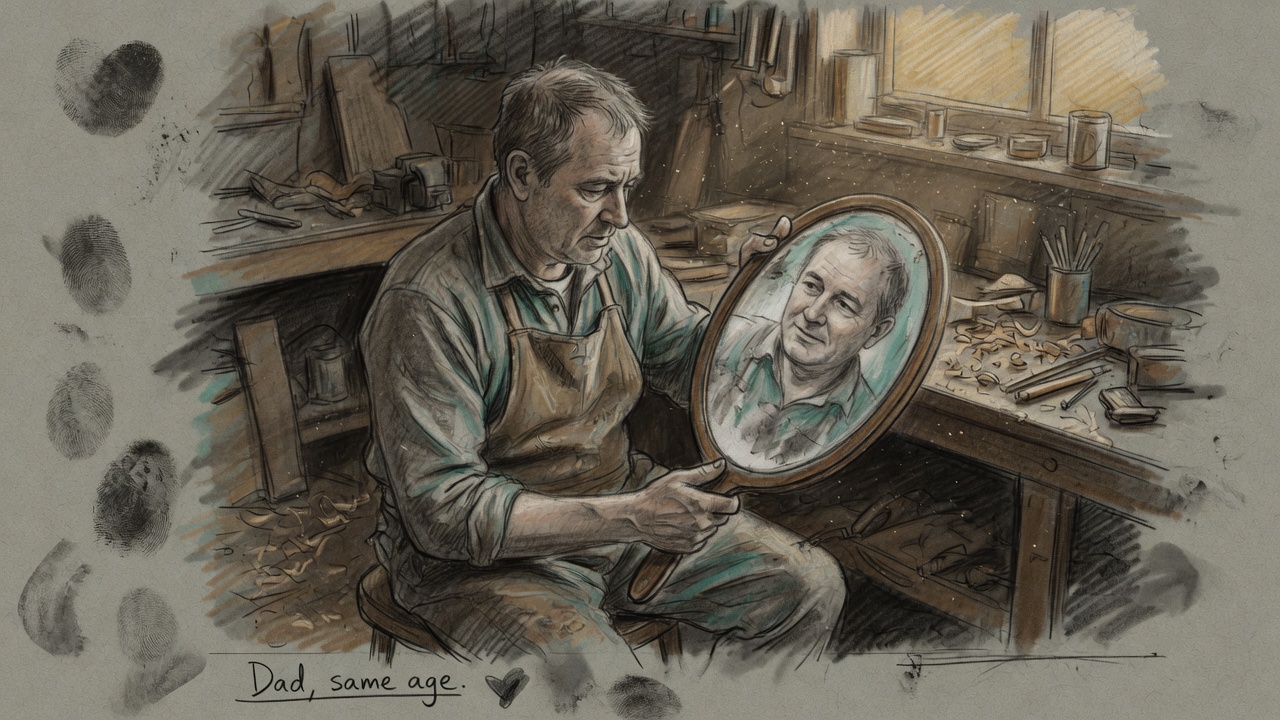
My father is sixty-eight years old, a retired Tucson plumber, and the only man in my life who has watched me make every important mistake from inside the same room. He is also, by the metrics of the father-wound discourse I have spent the last decade reading on the internet, supposed to be a problem.
He's not a problem. He's the best mirror I have.
I want to write this carefully because I know how it sounds. There is a whole industry — books, podcasts, men's retreats in cabins — built around the premise that most men are walking around with a wound shaped like their father, and the work of becoming a healthier man is the work of identifying that wound, mourning it, and graduating from it. I have read the books. I have been to one of the retreats. I cried in a sweat lodge in 2019 next to a forty-year-old hedge fund analyst who was screaming for the dad he never had. I am not going to mock that man. He needed the screaming. The screaming may have, in some real way, saved his marriage.
What I want to say is this: the father-wound narrative, taken as the default lens, can flatten the men who showed up.
And there are men who showed up. Imperfectly. Without grace. Without language. Without the right vocabulary or the right hugs at the right times. But they were in the room. They were in the truck. They were under the sink. They were not absent. They were not violent. They were just — and I mean this with affection — slightly inarticulate, weather-worn human beings who, in the absence of the manuals their sons would later read, did the best they could with the tools they were issued.
My father did not say I love you until I was twenty-two. He said it at my college graduation, with one hand on my shoulder, looking at the ground. It was awkward. It was a man clearing his throat into a sentence he had never practiced. I did not need it to be smoother. I needed it to be his.
Here is what my father did, that the father-wound discourse, in my reading, undervalues:
He showed up. Every day. To a job he did not love. For thirty-eight years. So that my mother could stay home with us, and later go back to school, and later still earn more than him without him ever once making a face about it.
He drove me to baseball practice in a 1989 Ford Ranger. We did not have what therapists call quality conversations. We had quantity conversations. Hours of low-stakes talking and not-talking, the radio on a country station he did not love either, his hand on the wheel, my elbow out the window. He taught me how to be quiet next to a man without being afraid of the quiet. That is, it turns out, a skill. It is a skill I use, every week of my adult life, in friendships and meetings and at funerals.
He taught me how to fix things. He let me fail at fixing things. He did not yell when I stripped the threads on a fitting. He said, okay, that's how that goes, and showed me again. He was teaching me, without saying it, that a man can break a thing and then learn the thing without being a broken man.
He let me cry, once, in 1996, when our dog died. He did not cry himself. I think now that he wanted to. He held a hand on my back. He said one sentence. He said: he was a good dog. That was it. That was the whole eulogy. It was enough. It is still enough.
None of that fits in the wound narrative. None of that becomes a chapter in a book.
What I notice, when I read about father wounds, is that the men in those books almost always have fathers who were either absent, violent, addicted, or grandiosely emotionally cold. Those men exist. Their wounds are real. I have a friend whose father, a banker, called him stupid every Sunday from age four to age fifteen. That is a wound. I will not minimize it.
But most fathers, in my observed sample of forty-seven years of life, are not those men. Most fathers, by my count, are like mine. Imperfect. Inarticulate. Available in some ways, unavailable in others. Loving without smoothness. Showing up without flair. Mediocre by literary standards. Decent by lived ones.
The father-wound frame, applied to those men, can manufacture a wound where there isn't one. I have watched it happen. I have watched friends, in their thirties, in the grip of a particular set of books and influencers, walk into therapy with a story about their dad's emotional unavailability that was, when I gently pressed on it, mostly the absence of I love you in childhood and the presence of forty years of dailiness that they were now retroactively coding as inadequate.
It was not inadequate. It was just, by the standards of contemporary discourse, undocumented.
My father is the best mirror I have because he sees me, still, after forty-seven years, with the kind of eyes that no other adult on earth has. My wife sees me beautifully and accurately, but she has only known me for nineteen years. My friends see me well, but they are not paying attention to me when I am not present. My therapist sees me skillfully, but she is, by design, in a particular role.
My father sees me from inside the long arc. He saw me at four. He saw me at fourteen, when I was insufferable. He saw me at twenty-three, when I left grad school and broke his heart a little because plumbing was, in his framework, a perfectly fine vocation, and grad school had been a stretch for him to believe in. He saw me at thirty-one when I got divorced, which he did not understand, and he flew to Tucson without being asked, and slept on my couch for four nights, and said almost nothing, and made coffee in the morning. He sees me now.
When I do something he does — I catch myself sighing the way he sighs, holding my coffee with both hands, going quiet at a stoplight — I do not experience it as an inheritance to escape. I experience it as a continuity. There is a man in Tucson, sixty-eight years old, of whom I am, in some real way, a continuation. When he is dead, those gestures will still be in the world, in my body, and later in my son's body, and that is — it turns out — what people mean by lineage.
The wound discourse wants me to grieve what he could not give me. Some of that grief, I have done. It was real. I sat with a therapist for two years, in my late thirties, and named the things I had wanted that he had not had the language for. That work mattered.
What the wound discourse does not, in my reading, give me language for is the gratitude. The deep, daily, slightly inarticulate gratitude for what he did give. Which was, in essence: presence without flourish. Reliability without speech. Love without the word.
I have spent the last ten years learning how to add the word. He has spent the last ten years, watching me, learning how to use it himself. He says it now, on the phone, almost every time. He still clears his throat first. I love that he clears his throat. The throat-clearing is part of the love. It is part of the lineage. I do not want to edit it out.
If you have a father who showed up, even imperfectly, this is what I would say to you:
Do not, before he is gone, write him into the wound. Some of him is wound. Most of him, probably, is mirror. The mirror is the thing you will lose first, and miss longest.
Sit next to him in the truck if he is still alive. Do not require the conversation to be deep. Let it be a conversation about transmissions or the price of avocados or the neighbors' dog. Those conversations are, in their cumulative weight, more nutritious than the one big confessional conversation you are imagining you should have. The big conversation, if it comes, will come on top of a thousand small ones. It cannot come without them.
Notice his gestures. Catch yourself doing them. Do not flinch. The gestures are not a curse. They are an inheritance you are allowed to keep, the way you keep a watch.
And — this is the part the wound books almost never say — thank him. While he is alive. With your specific words, not the smoothed version. Tell him, awkwardly, the way he taught you to be awkward, that you noticed. Tell him you noticed the truck rides. Tell him you noticed the day in 1996 when the dog died. Tell him you noticed that he did not yell when you stripped the threads.
He will clear his throat. He will say well, sure, or that's good, or okay. He will be saying, in his vocabulary, I love you too. I have always loved you. I just didn't have the manual.
You don't need a different father. You need to learn to read the father you have.
If you want to read the other half of this exchange, my colleague's counterpoint describes the same dynamic from a daughter's perspective. If you are trying to start the kind of conversation I describe, our scripts for talking to your dad may help, and our walkthrough for the situation where his father is dying is written for the long arc.