I read Carlos's piece three times before I knew how to answer it.
I want to start by saying I agree with most of it. The father-wound industry has, in fact, become a flattening device. Most fathers are not monsters. Most fathers are men who showed up imperfectly, and that showing-up matters, and the gratitude Carlos describes — the throat-clearing love, the truck-ride continuity — is real, and worth defending, and undocumented in most of the discourse he is pushing back on.
I am not writing to take that from him. I am writing to add what I do not think his piece, beautiful as it is, can fully see from where he stands.
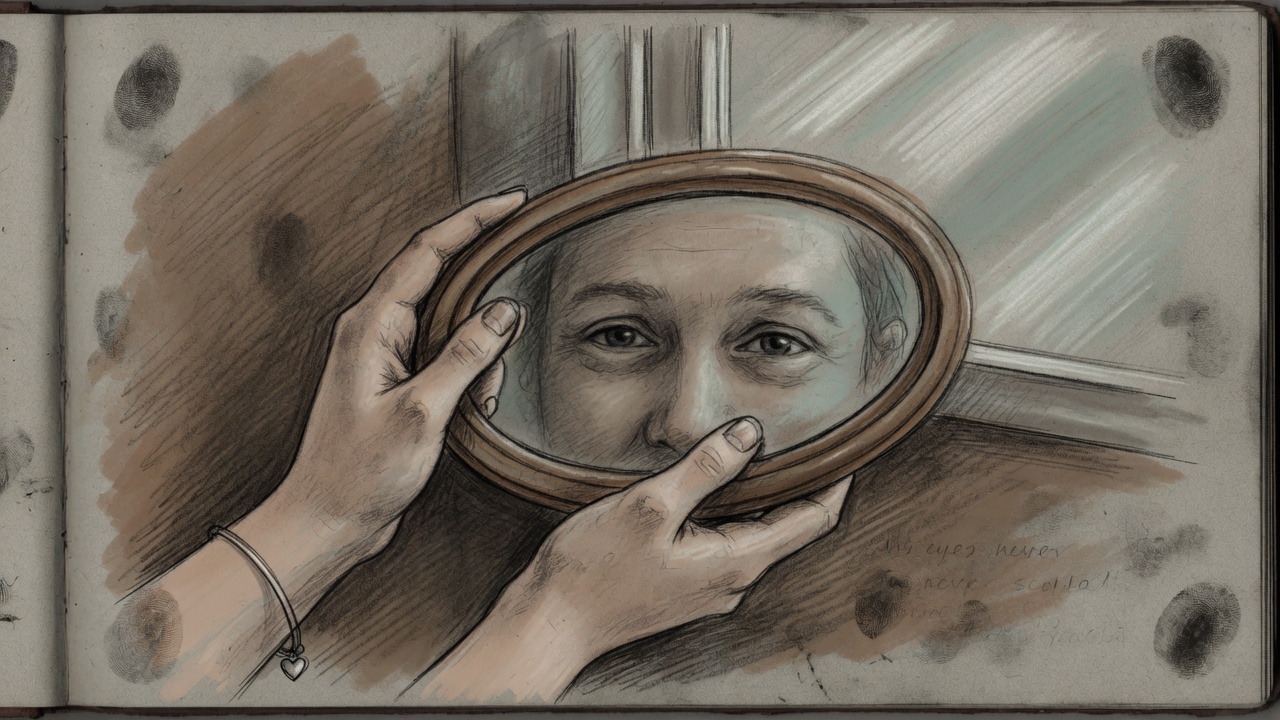
The mirror has two sides. He is on one. I am on the other.
My father was, by every metric Carlos lists, a good father.
He showed up. He drove me places. He worked a job he did not love so my mother could finish her residency. He held my hand at my grandfather's funeral. He let me cry at sixteen when my first boyfriend was cruel to me. He said one sentence — he was not worthy of you — and that sentence is still, twenty-five years later, one of the most important sentences anyone has ever said to me.
He is also a man who, when I was eleven, stopped touching me.
I want to be careful with that sentence, because in 2026 the words stopped touching me in a piece about fathers and daughters do a particular kind of work, and I do not mean what those words usually mean. I mean: he stopped hugging me the way he had hugged me when I was small. He stopped sitting next to me on the couch. He stopped tousling my hair. He retreated, gently and totally, to a respectful distance from his daughter's body in a way he did not retreat from his son's. He did not stop loving me. He stopped knowing how to express affection to a girl who was no longer a child but was also clearly his child.
I did not have the language for this until I was thirty-two and watched him pull my eight-year-old niece into a bear hug at Christmas, and I felt, in my chest, a small bright pang of grief for the eleven-year-old me who had stopped being eligible for that kind of hug because of something nobody, including her, had voted on.
Carlos writes about his father as a mirror — a man who has watched him over forty-seven years and reflects him back to himself with a depth no other adult can match. I believe that. My brother has that mirror. He is forty-three. He calls our father every Sunday. They talk about basketball and trucks and the price of avocados. Their relationship is, in its undramatic dailiness, one of the great loves of both their lives.
I do not have that mirror.
I have a different one. I have a father who, when I was sick, took me to the doctor without complaint. Who showed up at my dissertation defense in a suit that did not fit him and cried in the back row, which I only learned years later. Who paid for my wedding without being asked, and walked me down the aisle, and gave a speech that said, almost verbatim, I am proud of her, I do not always know how to talk to her, but I am proud of her. He said the second clause out loud. In front of two hundred people. I have thought about it for fifteen years.
My father is not a wound. He is, in Carlos's framing, a mirror. But the mirror he holds reflects a girl he stopped knowing how to look at directly when she was eleven. So what the mirror gives me is a slightly averted version of myself. The version of me that he could meet. The version that did not require him to update the manual he was issued in 1962, in a Korean Methodist church in Chicago, by men who had no idea what to do with their daughters once their daughters had bodies.
The wound, if you want to call it that — and I do not, particularly — is not in him. The wound is in the manual. The wound is in what he was not given to give.
Here is what I want to add to Carlos's piece, gently, from the other side of the room:
When a father is the mirror, the son and the daughter see different things in him.
The son sees the father's back. They sit shoulder to shoulder. They look out at the same world. The continuity Carlos describes — the gestures, the throat-clearing, the lineage — is mostly visible from that angle. It is the side-by-side angle. It is the truck angle. It is, I think, what fathers and sons, when it works, get to have.
The daughter sees the father's face. Or doesn't. The daughter is in the seat across from him, not the seat next to him. The daughter is looking for an expression that says I see you, in the way Carlos describes his father seeing him, and what she often finds — even with a good father, even with a present father, even with a father who did everything Carlos's father did — is a slight, courteous, kind, very slightly averted gaze. Because the manual the father was issued did not include the chapter on how to look directly at a daughter who has become a woman without becoming a stranger.
I am not saying this is every father. I have friends with fathers who got the chapter, who held them through their twenties and thirties with full presence, who cry openly at their birthdays. Those men exist. They are, in my anecdotal sample, rarer than the men Carlos and I are both describing.
What I am saying is that the father-as-mirror frame, as Carlos uses it, is a true frame for sons. It is a partially true frame for daughters. The other half — the part the mirror cannot reflect because the mirror is angled the wrong way — is something daughters carry, often privately, often without the language Carlos's framework gives sons, and often with no resentment at all toward the actual father, who did the best he could with what he was given.
I will tell you what I have done with this, because it matters more than the diagnosis.
I have stopped waiting for my father to update the manual. He is sixty-nine. He is not going to update it. He is going to die, in some year, with the same manual he was issued in 1962, and that is okay. That is, in fact, the only honest read of who he is.
What I have done instead is a small thing. I have taken my father's love and translated it. The hug he can no longer give me — I have given to my niece. I sit next to her on the couch the way he used to sit next to me. I tousle her hair. She is eight. When she is eleven, I will keep doing it. I will not stop. I will be the version of my father that the manual did not allow him to be. I will be it for her, and through her, in some strange retroactive way, for me.
I have learned how to ask my father questions that do not require him to update the manual. I do not ask him how he feels. He does not have answers to that question. I ask him what he is working on. I ask him about the truck. I ask him about my mother, whom he loves with a clarity he can almost articulate. I am letting him love me in his vocabulary, instead of asking him to learn mine. Carlos's piece named this. I think he is right about it.
And — this is the part Carlos's piece, written from the son's chair, could not quite include — I am writing this, here, so that the daughters reading it know they are not alone in noticing the slightly averted gaze. The averted gaze is not your father's failure. It is the manual's failure. Your father is not a wound. The manual is the wound. You are allowed to grieve it without grieving him.
Carlos ends his piece with: you don't need a different father. you need to learn to read the father you have. I would add one sentence to that, from the other side of the mirror:
And you need to write the chapter the manual didn't have. Not for him. For the children — yours, your siblings', your friends' — who are coming up behind you. The mirror has two sides. The side your father gave you is yours to keep. The side he could not give you is yours to make.
I am making mine, slowly, in Seattle, with a niece, and a journal, and a long memory of a man in a suit that did not fit him, crying in the back row of a dissertation defense in 2018. He could not have told me, in person, what that meant. I have learned to hear him, retroactively, anyway. The mirror is, on its second side, also a hearing.
Read Carlos's original piece for the male voice this responds to. If you are sitting with the slow weight of longing for a parent who is here but partially out of reach, the journal prompts tool has 200+ prompts for exactly this. And the walkthrough for fathers who shut down conversations has scripts for when you want to try, gently, anyway.