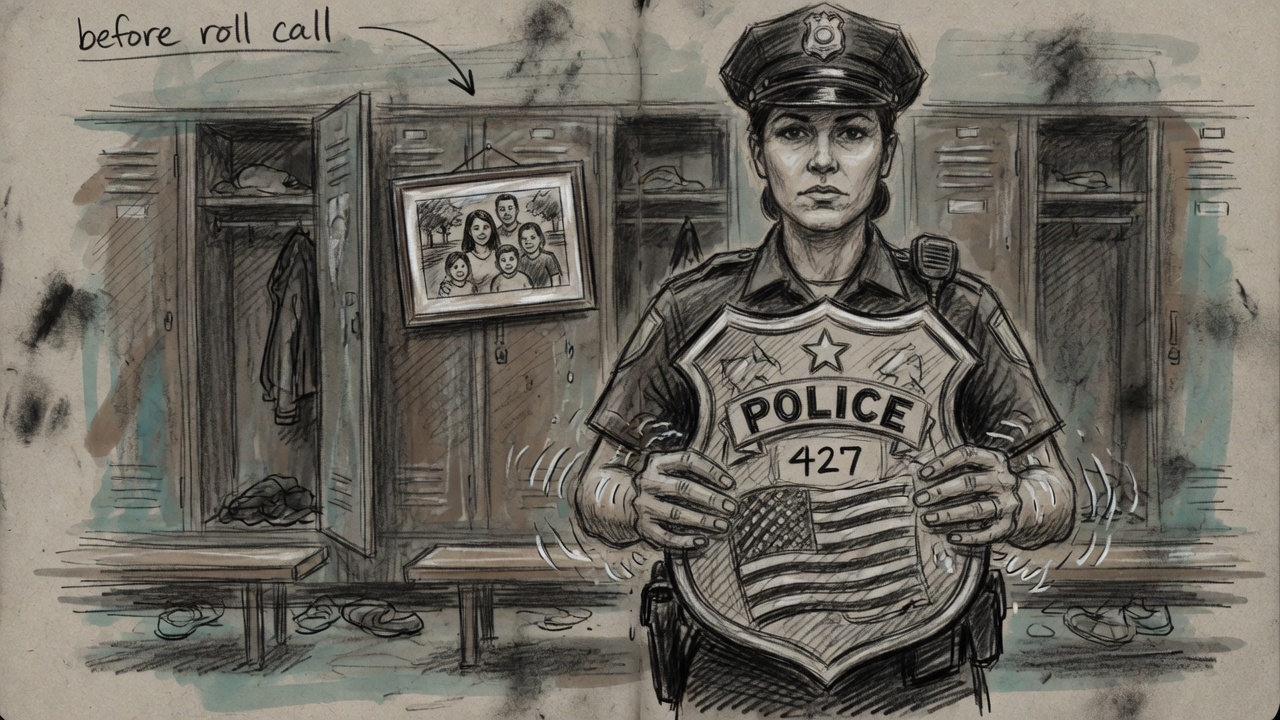
Subject: The quiet crisis nobody in law enforcement wants to name.
Classification: Personal testimony. Not official.
Years of observation: 30.
The Culture
I joined the BPD in 1993. I was one of eleven women in my academy class of eighty-six. By the end of the first year, four of us remained. The others didn't wash out because they couldn't handle the work. They washed out because the culture made it clear, every day, in a hundred small ways: this is not your house.
But this testimony isn't about what the culture did to the women. It's about what it did to the men. Because I watched. For thirty years, I watched. And what I saw was a system that consumed men methodically, praised them for their endurance, and then discarded them when the endurance ran out.
The badge is an identity. It’s not a job identity—it’s an identity identity.
— Patricia O., 58
The Mechanism
Here's how it works:
Year one: You see something that changes you. A shooting. A car accident with a child. A domestic call where the damage is hours old and the victim has stopped crying because crying stopped working. You go back to the station and the veterans say, "First one's the hardest." They're lying. They're all hard. But you learn the script: absorb it, file it, move on.
Year five: You've filed a lot. The cabinet is getting full. You start having trouble sleeping. You drink a little more. Your spouse asks if you're okay and you say "I'm fine, it's the job." The job becomes the explanation for everything—the distance, the short temper, the way you sit in the driveway for ten minutes before going inside because you need to switch from cop mode to human mode and the switch is getting slower.
Year fifteen: Someone you know eats their gun. (That's the phrase. I'm not going to soften it. If the language bothers you, imagine how the reality feels.) The department offers counseling. Almost nobody goes. Going means admitting the job broke you, and broken cops don't get promoted. Broken cops get desk duty. Broken cops get whispered about.
Year twenty-five: You're a veteran now. You're the one telling rookies "first one's the hardest." And somewhere in the back of your mind, you know you're passing down the same lie that was passed to you. But the alternative—saying "this job will damage you and nobody here will help you process it"—that doesn't fit on a training slide.
What I Saw
I saw men who could chase a suspect through a housing project at full sprint but couldn't sit with their own thoughts for five minutes.
I saw men who responded to active shooter calls without hesitation but flinched when their kids dropped a plate at dinner.
I saw men who went from a death notification—standing in someone's living room, telling a mother her son was dead—straight to the next call, because the radio doesn't pause for grief.
I saw my partner, Danny Callahan, nineteen years on the job, funny as hell, best cop I ever worked with, deteriorate over three years from a guy who sang in the car to a guy who sat in silence with his jaw clenched. When I asked him what was wrong, he said, "Nothing's wrong. I'm just tired."
He retired in 2018. By 2019 he was in a VA facility for alcohol dependency. He's better now. But "better now" means he can sleep without medication. That's the bar.
What I Know Now
The badge is an identity. It's not a job identity—it's an identity identity. The way priests are priests and soldiers are soldiers. You don't take it off at the end of your shift. It lives in your posture, your vigilance, the way you scan every room you enter for exits and threats.
And built into that identity is a prohibition: do not be weak. Weakness gets people killed. On the street, that's true. In a firefight, you need the person next to you operating at full capacity. The prohibition has a logic.
But the prohibition doesn't have an off switch. It extends from the street to the station to the home to the therapist's office that nobody visits. It's total. It's all-weather. And it is destroying men who deserve better.
More law enforcement officers die by suicide than in the line of duty. I want you to read that sentence again. The job is not the leading cause of death. The aftermath of the job is.
“More law enforcement officers die by suicide than in the line of duty. The job is not the leading cause of death. The aftermath of the job is.” Click to tweet →
What I'd Change
If I could redesign police culture—and I say this as someone who loves the job, who is proud of the shield, who would do it again—I would make three changes:
Mandatory debrief after critical incidents. Not optional. Not suggested. Mandatory, the way body armor is mandatory. You wouldn't send a cop onto the street without a vest. Don't send them home after a trauma without a conversation.
Peer support that's actually confidential. The current system is a joke. Everyone knows that going to EAP gets flagged. Informal peer support—cop to cop, off the record, trained but not clinical—is the only model that will work in this culture. Meet the men where they are, not where you want them to be.
Retirement preparation that addresses identity. Nobody trains you for the silence after the radio stops. You go from a life of purpose and adrenaline and belonging to a pension and an empty Tuesday. The transition breaks people because we treat retirement like an ending instead of what it actually is: the most dangerous shift of your career.
Final Note
I'm retired now. I sleep okay. I have a dog. I volunteer with a group that supports law enforcement families.
Danny called me last month. First time in a year. He said, "Patty, do you ever miss it?"
I said, "Every day."
He said, "Me too. But I don't miss who I was becoming."
That's the most honest thing a cop has ever said to me. And he said it from the other side, after the breaking, after the facility, after the work of rebuilding.
I wish he could have said it sooner. I wish any of them could. I wish the culture made room for a sentence like that before the breaking instead of after.
Thirty years. Shield #4417. End of testimony.
Point / Counterpoint
Read the other side → Two Kinds of BraveJoin the Conversation
Have a story about masculinity, identity, or what it means to be a man today? We want to hear it.
Share Your Story →