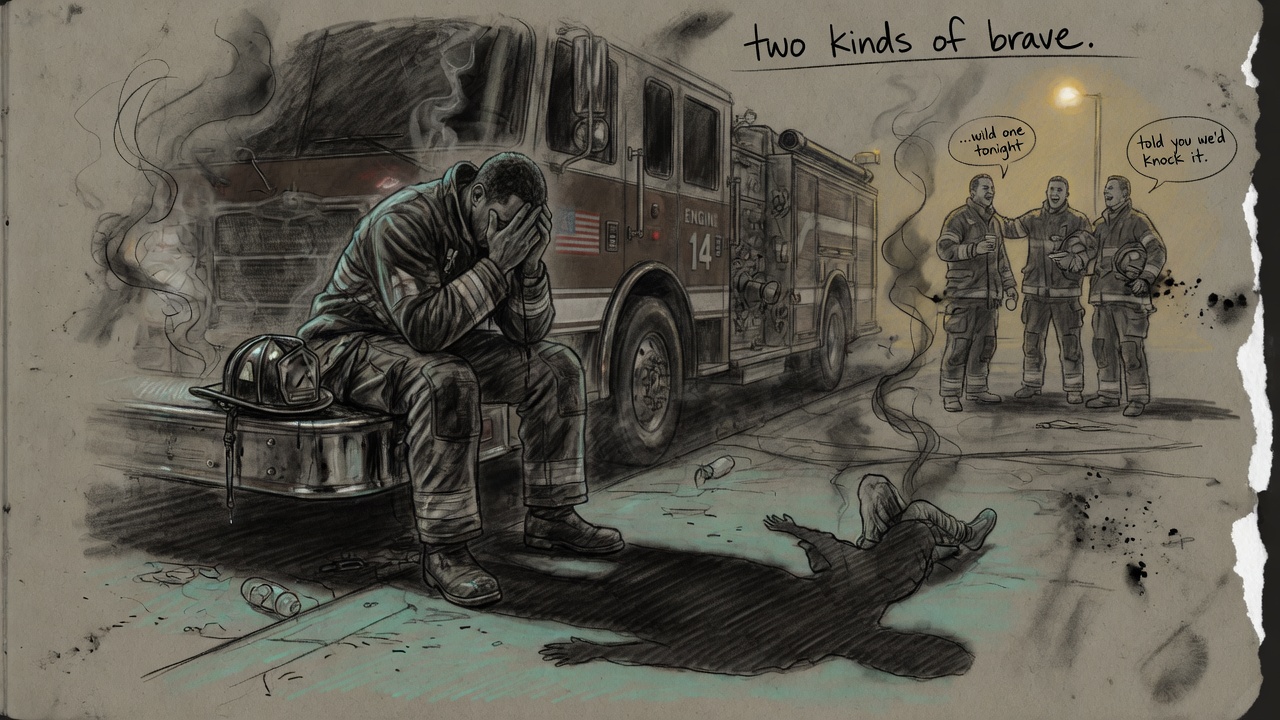
I can tell you the exact weight of a halligan bar: 10.5 pounds. The temperature at which drywall ignites: around 450 degrees. The number of seconds you have to make a decision when a ceiling starts sagging: less than you'd think.
I can't tell you the last time I slept through the night.
People call us brave. I've heard it a thousand times—at the grocery store, at my daughter's school, at cookouts where somebody finds out what I do and suddenly wants to shake my hand. "Thank you for your service. You guys are heroes."
I appreciate it. I do. But bravery is a funny word. Running into a structure fire isn't brave for me anymore. It's trained. It's muscle memory. I know where to step, how to breathe, when to pull back. The fire is predictable. You study it long enough and it starts to make sense.
You know what doesn't make sense? The four-year-old we lost on Oakdale Road three Christmases ago. The way her room was exactly the size of my daughter's room. The purple walls. The stuffed elephant on the floor that somehow didn't burn.
That elephant lives in my head rent-free. It shows up at 2 AM when my wife is sleeping and I'm staring at the ceiling running the call again. Could I have been faster? Was there another thirty seconds? I know the answer is no. My captain told me. The investigator told me. The chaplain told me. My body doesn't believe any of them.
We’re trained to rescue people from buildings. Nobody trained us to rescue each other from silence.
— Andre J., 35
There are two kinds of brave, and the first one—the running-in kind—is the one that gets your picture in the paper. The second kind is the one nobody talks about.
The second kind is sitting in a room with a stranger who has a degree on the wall and saying: "I'm not okay."
I watched my lieutenant—toughest man I know, twenty-two years on the job—retire last spring. Three months later, his wife called the station. He'd been drinking alone every day since he turned in his badge. Without the job, without the crew, without the adrenaline, he didn't know who he was. He had no language for what was happening to him, so he poured bourbon on it.
We went to see him. Six guys from the station, standing in his living room, and nobody knew what to say. We're trained to rescue people from buildings. Nobody trained us to rescue each other from silence.
“We're trained to rescue people from buildings. Nobody trained us to rescue each other from silence.” Click to tweet →
Last month I did something that scared me more than any fire.
I called the department's Employee Assistance number. I sat in my truck in the parking lot of a Walgreens for twenty minutes before I dialed because I didn't want anyone at the station to see me on the phone. When the woman answered, I said, "I think I need to talk to someone," and my voice cracked on "someone" and I almost hung up.
I didn't hang up.
It's not fixed. I'm not going to sit here and write a fairy tale about one phone call changing everything. I still see the elephant. I still run the call. But now I run it with someone who asks the right questions and doesn't judge the answers.
The guys at the station don't know. I haven't told them. Maybe that's the next kind of brave—saying it out loud to the people who need to hear it most. But I'm not there yet.
I can carry a grown man down a ladder in full gear. I can force open a steel door with a halligan bar that weighs 10.5 pounds. But saying "I'm struggling" to my crew might be the heaviest thing I ever lift.
“I can carry a grown man down a ladder in full gear. But saying "I'm struggling" to my crew might be the heaviest thing I ever lift.” Click to tweet →
I'm working on it.
Point / Counterpoint
Read the other side → Behind the Badge: What 30 Years Taught Me About Men BreakingJoin the Conversation
Have a story about masculinity, identity, or what it means to be a man today? We want to hear it.
Share Your Story →