Licensed couples therapist. Expanded from "The Vocabulary Gap: Notes From Couples Therapy."
I keep a feelings wheel on my office wall. I wrote about it before—how men hover around three zones while women navigate the full spectrum. The piece resonated. Therapists shared it. Women tagged their partners. "See? This is what I've been saying."
But a response I didn't expect started arriving in my inbox. From men. Thoughtful, frustrated, articulate men who said some version of: "What if the feelings wheel is the problem, not us?"
At first I dismissed it. Defensive, I thought. Classic resistance. Then I did what I tell my clients to do: I sat with the discomfort instead of explaining it away. And I started asking a question that made me uncomfortable in my own practice:
What if the therapeutic framework I use—the one I was trained in, the one I believe in—has a gender bias I haven't examined?
The Female Baseline
Here's the premise of most emotional intelligence frameworks: the ability to identify, name, and verbally express a wide range of emotions is the gold standard of psychological health. The more granular your emotional vocabulary, the healthier you are. If you can distinguish between "frustrated" and "resentful" and "disappointed," you're doing well. If everything is "fine" or "angry," you need work.
This framework was built primarily by researchers studying populations that skew female in participation. The therapeutic profession is 70% women. The clients who voluntarily seek therapy skew female. The emotional vocabulary that gets validated as "healthy" is, disproportionately, the vocabulary women were socialized to develop.
Who Shapes the Therapeutic Standard?
70%
Female therapists
30%
Male therapists
Author's analysis of the therapeutic profession's gender composition
I'm not saying the framework is wrong. I'm saying it might be incomplete. And incompleteness, in a clinical setting, can look a lot like bias.
When a man sits on my couch and says "I'm fine" and I interpret that as emotional avoidance, I'm measuring him against a standard he didn't set, wasn't trained for, and may not need in the form I'm prescribing.
What if "I'm fine" isn't always a wall? What if, sometimes, it's a different processing style that I've been trained to pathologize?
Are we asking men to be vulnerable in a culture that hasn’t actually made vulnerability safe for them?
— Rachel G., 30
The Action Channel
A colleague of mine—male therapist, fifteen years of practice, specializes in men—introduced me to a concept he calls "the action channel." His argument: men don't lack emotions. They express emotions through action rather than language, and the therapeutic world has decided that only the language channel counts.
When a man can't sleep and goes to the garage to rebuild a carburetor at midnight, that's emotional processing. It's just not verbal. When a father coaches his son's baseball team every Saturday because he can't say "I love you" easily, the coaching IS the expression. When a man hears his partner is stressed and immediately starts solving the problem instead of validating the feeling, he's not failing at empathy. He's running empathy through a different protocol.
The therapeutic establishment says: "Yes, but he needs to also be able to SAY it."
Why?
Genuine question. Why is the verbal channel the requirement? If the emotion is being processed—if it's moving through the body, being expressed in behavior, resulting in functional outcomes—why is the specific act of naming it out loud the bar for health?
The answer I was trained to give: because unexpressed emotions become somatic symptoms, because verbal processing creates intimacy, because naming a feeling reduces its power.
The answer that's starting to bother me: because the people who built the framework process verbally, and we assumed our way was the way.
The Relationship Double Bind
This is where it gets really controversial, and I need to be careful, because I'm about to say something that my profession doesn't like to hear:
Some of the women in my practice who beg their partners to be more emotionally open punish that openness when it arrives.
Not consciously. Not maliciously. But measurably.
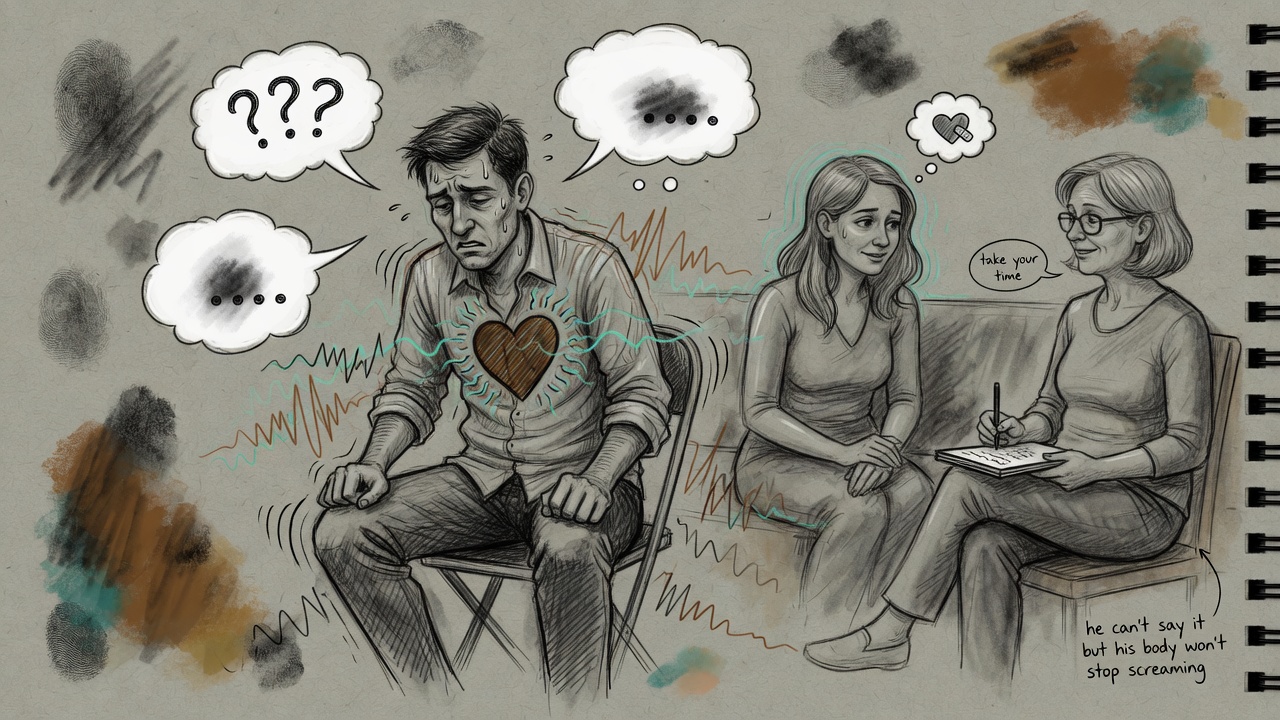
I've watched it happen in session. A man finally breaks through. He says, "I'm scared. I don't know if I'm a good enough father. I feel like I'm failing." Textbook vulnerability. Exactly what the therapeutic model prescribes.
And his partner's face changes. It's micro. It's fast. But I'm trained to see micro-expressions, and what I see is: a flash of something that looks like disappointment. Or fear. Or recalibration. The mental model she held of him—strong, steady, the rock—just shifted, and the new model is less stable than the old one.
She'll say the right things: "Thank you for sharing that. I appreciate your honesty." But over the next three sessions, she'll reference the disclosure differently. "Remember when you said you felt like you were failing?" It's no longer an act of bravery. It's become evidence.
I have seen men open up in my office and then watch that openness get weaponized in the next argument. "You SAID you don't know what you're doing." The vulnerability was invited, received, and then filed for future use.
Not every woman does this. Not every time. But enough that I've started to wonder: are we asking men to be vulnerable in a culture that hasn't actually made vulnerability safe for them?
“Are we asking men to be vulnerable in a culture that hasn't actually made vulnerability safe for them?” Click to tweet →
We tell men: "Open up. Share your feelings. Be vulnerable."
But the unspoken contract often reads: "Be vulnerable in the way I find attractive. Show me your soft side, but not too soft. Cry at the movie, not at the mortgage. Be open about your feelings for me, not about your fear of inadequacy."
This is a double bind, and I built part of my practice on one side of it without seeing the other.
What I'm Reconsidering
I'm not abandoning the feelings wheel. Emotional vocabulary is a real tool that helps real people. Men who learn to distinguish between anger and grief and shame genuinely benefit.
But I'm reconsidering three things:
1. The assumption that verbal expression is the only healthy channel.
If a man processes grief by running ten miles, and after the run he feels lighter, and he can re-engage with his family with presence and patience—did he fail to process the grief because he didn't name it out loud? Or did he process it through a channel I wasn't trained to validate?
I'm starting to think the therapeutic world needs to recognize action-based emotional processing as legitimate, not as a consolation prize for men who "can't" verbalize.
2. The assumption that women's emotional style is the standard.
Women talk more about feelings. This is documented. But "more" isn't automatically "better." I've had female clients who over-process—who talk about a feeling so extensively that the talking becomes a substitute for resolution. Rumination dressed as insight. If I held female emotional processing to the same critical lens I hold male processing, I'd have to admit: both styles have failure modes. We just only pathologize one of them.
3. The assumption that vulnerability is always safe to prescribe.
I've been telling men to open up in a world where opening up has real social costs—in relationships, in workplaces, in friendships. If I prescribe vulnerability without also addressing the environments that punish it, I'm setting my clients up for harm and calling it healing.
The Real Gap
The vocabulary gap is real. I still see men who genuinely cannot access their own emotional states, who are so disconnected from their inner lives that anger is the only signal that makes it through. Those men need help. The feelings wheel helps them.
But the gap I'm more worried about now is the one in my own profession: the gap between what we prescribe for men and what the world actually rewards. We sit in climate-controlled offices and tell men to be vulnerable, and then they walk out the door into jobs, relationships, and communities that still punish vulnerability in men while celebrating it in women.
“We sit in climate-controlled offices and tell men to be vulnerable, and then they walk out the door into jobs, relationships, and communities that still punish vulnerability in men.” Click to tweet →
The feelings wheel is a tool. But a tool is only as good as the environment it's used in. And right now, I'm not sure the environment is ready for what we're asking men to become.
That's not a reason to stop. It's a reason to be honest about the cost.
I owe my male clients that honesty. I'm starting to pay it.
Join the Conversation
Have a story about masculinity, identity, or what it means to be a man today? We want to hear it.
Share Your Story →