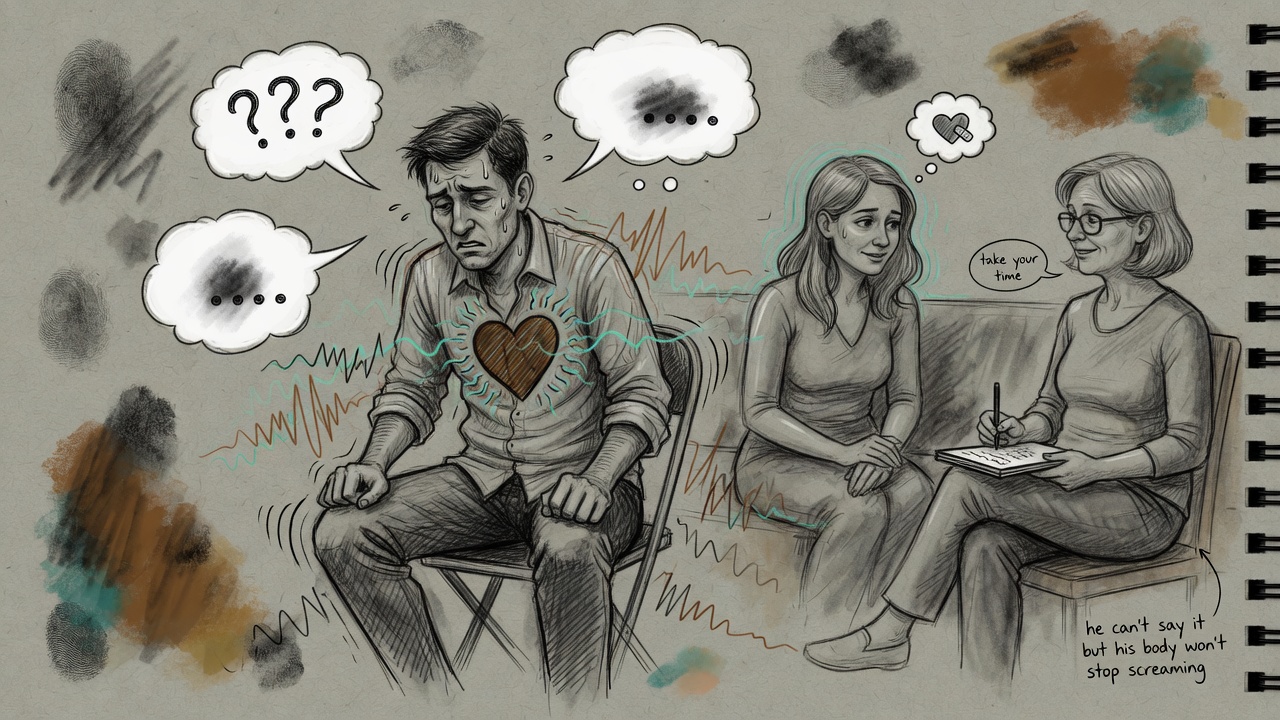
Session 1 — The Presenting Problem
They come in and she talks for twelve minutes. He sits with his arms crossed. When I turn to him and ask how he's feeling about what she just said, he says: "Fine."
I wait.
"I mean, I don't disagree."
I wait longer.
"She's right, I guess. I don't know."
Three sentences. Zero feelings. This is the most common opening in my practice.
Session 4 — The Wheel
I keep a feelings wheel on my wall. It's a circle divided into sections: anger, sadness, fear, joy, surprise, disgust. Each section branches into more specific words. Anger becomes frustrated, bitter, hostile, violated. Sadness becomes lonely, guilty, ashamed, empty.
I ask men to point at the wheel when words fail. Most of them hover around the same three zones: angry, stressed, fine. Fine isn't even on the wheel.
The Emotional Vocabulary Funnel
Last Tuesday a man stared at the wheel for a full minute, pointed at "overwhelmed," and then immediately said, "But it's not a big deal." He identified the feeling and dismissed it in the same breath. Reflex.
Don’t fill the silence for him. Wait. It’s uncomfortable. Wait anyway. The sentence is coming. It just takes longer than you think.
— Rachel G., 30
Session 7 — The Translation Layer
Here's what I've learned: most men in my office aren't emotionless. They're under-translated. The feelings are there—I can see them in the jaw clench, the leg bounce, the way they suddenly need water right when we hit something real. The signal exists. The vocabulary doesn't.
Women are often socialized with a rich emotional language from childhood. "Use your words." "How did that make you feel?" "Tell me about your day." Boys get: "You're okay." "Shake it off." "Be tough."
By the time they're sitting on my couch at 35, they've had decades of practice not naming things.
Session 12 — The Breakthrough That Doesn't Look Like One
He says: "I think I'm scared."
She starts to respond and I hold up my hand. Not yet.
"I'm scared that if I say the wrong thing you'll leave. So I say nothing. And you're leaving anyway because of the nothing."
This is the moment. It's not dramatic. There's no crying, no movie scene. He says it like he's reading a grocery list. Flat. Controlled. But his hands are shaking.
She reaches for his hand. He lets her take it.
This is what progress looks like in my office. Not a revolution. A single honest sentence after months of silence.
A Note to Readers
I'm not writing this to blame men or pity them. I'm writing this because the vocabulary gap is real and it's wrecking relationships I could otherwise help save.
If you're a man reading this: anger is almost never the primary emotion. It's the bodyguard. The thing it's protecting is usually fear, grief, shame, or loneliness. You don't have to perform a TED talk about your feelings. You just have to try one honest sentence.
If you're anyone who loves a man: don't fill the silence for him. Wait. It's uncomfortable. Wait anyway. The sentence is coming. It just takes longer than you think.
“Don't fill the silence for him. Wait. It's uncomfortable. Wait anyway. The sentence is coming. It just takes longer than you think.” Click to tweet →
The wheel is on my wall for a reason. Sometimes you need a map to find words for places you've always been.
Join the Conversation
Have a story about masculinity, identity, or what it means to be a man today? We want to hear it.
Share Your Story →