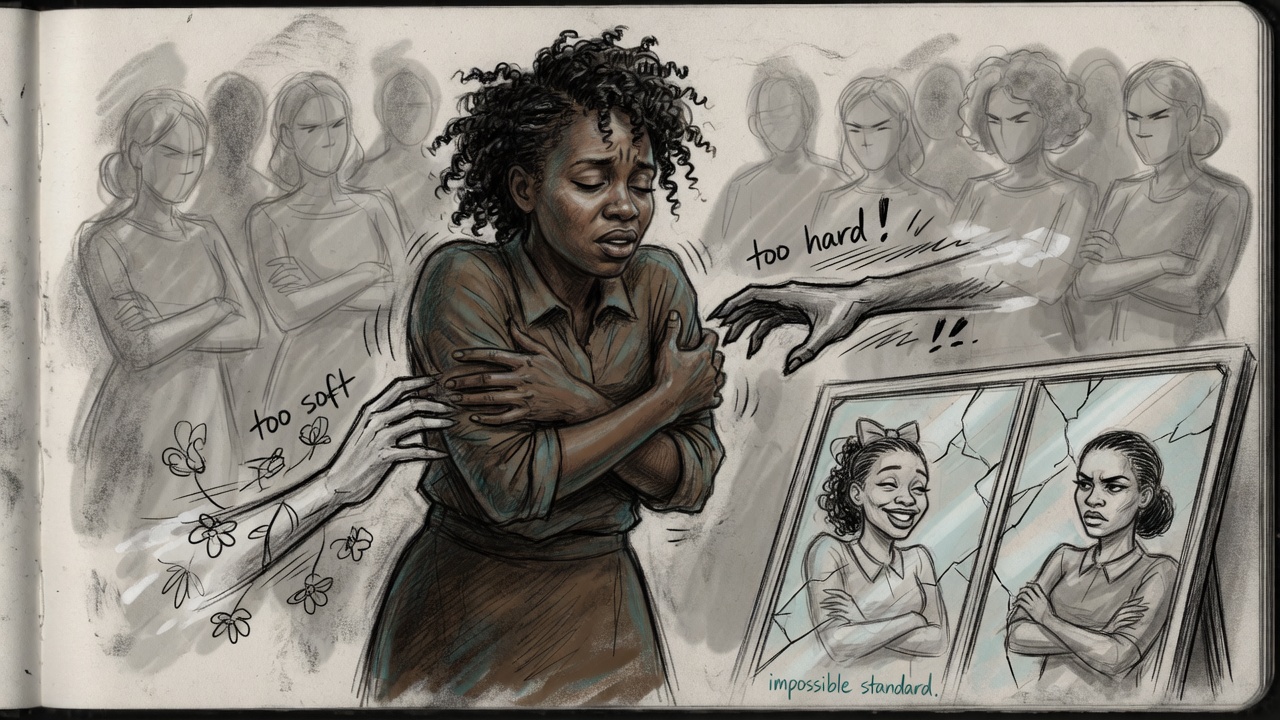
In twenty years of studying how race and gender shape identity, one finding recurs with disheartening consistency: Black men in America occupy a paradox that has no clean resolution. Society simultaneously fears their strength and mocks their vulnerability.
“Society simultaneously fears their strength and mocks their vulnerability. This is the double bind.” Click to tweet →
This is the double bind.
It operates like a psychological trap with no exit. Express power, confidence, or assertiveness—behaviors rewarded in white men as "leadership"—and you activate a centuries-old threat narrative. You become dangerous, aggressive, someone to cross the street to avoid. Express sadness, uncertainty, or tenderness—behaviors increasingly encouraged by mainstream wellness culture—and you are diminished. Soft. Not a real man. Or worse: performing for approval.
The bind is not theoretical. It is measurable.
In the data:
A 2024 study from the American Psychological Association found that Black boys as young as ten are perceived as older, less innocent, and more culpable than their white peers. They are assigned adult motives for childlike behaviors. A white ten-year-old throwing a tantrum is having a bad day. A Black ten-year-old throwing a tantrum is a discipline problem.
Simultaneously, research on help-seeking behavior shows that Black men are the demographic least likely to pursue mental health treatment—not because the need is absent, but because the cost of appearing vulnerable is higher. In communities where strength is a survival strategy (and it has been, historically, necessarily), admitting struggle feels like an existential risk.
The message synthesizes to: Be strong, but not threatening. Be vulnerable, but not weak. Thread a needle that doesn't exist.
The Double Bind
“Be strong, but not threatening. Be vulnerable, but not weak. Thread a needle that doesn't exist.” Click to tweet →
Be strong, but not threatening. Be vulnerable, but not weak. Thread a needle that doesn’t exist.
— Amara N., 47
In the classroom:
I teach a seminar called "Masculinity and Race in America." Every semester, I ask my students—a mix of genders and races—to list five words they associate with "Black man." The answers are remarkably stable year to year:
From non-Black students: strong, athletic, cool, intimidating, absent father.
From Black male students: tired, watched, misunderstood, expected, invisible.
The gap between those two lists is where the double bind lives. One list is about projection—what society maps onto Black male bodies. The other is about experience—what it actually feels like to live inside those projections.
Perception Gap: "Name 5 Words for Black Man"
Outside
Strong, athletic, cool, intimidating, absent father
Inside
Tired, watched, misunderstood, expected, invisible
Author's classroom exercise, consistent across semesters
"Tired" appears on the Black male students' list almost every time. Not physically tired. Tired of performing. Tired of calibrating. Tired of calculating how much space to take up in a room.
In the culture:
We are in an era that celebrates emotional openness—therapy speak, vulnerability podcasts, "it's okay to not be okay" merchandise. And this cultural shift has been, broadly, positive.
But access to that shift is not equally distributed.
When a white male celebrity cries in an interview, he is brave and authentic. When a Black male celebrity does the same, the commentary splits: some praise him, others question his sincerity, and a third group—often within the Black community itself—worries he is performing weakness for a white gaze.
This internal critique is not cruelty. It is a protective instinct born from generational experience: vulnerability, in the wrong context, gets Black men killed. Emmett Till was fourteen. Philando Castile complied. The historical ledger teaches that softness is not always safe.
So Black men are asked to evolve emotionally in a society that has not yet evolved its perception of them. Be open, we say—but understand that openness will be interpreted through a lens that still codes you as threat.
Toward resolution:
I don't believe the double bind dissolves with individual effort alone. It is structural. It requires:
1. Specificity in wellness messaging. "Men should be more vulnerable" is incomplete. Which men? In what contexts? With what safety nets? Universal prescriptions ignore the reality that vulnerability is not equally costly.
2. Community-based models. The most effective interventions I've seen don't come from therapists' offices. They come from barbershops, coaching staffs, church groups, and mentorship circles—spaces where Black men are already gathered and where trust is pre-existing.
3. Honest reckoning with perception. Until the broader culture can see a Black man expressing emotion without filtering it through fear or condescension, the invitation to "just be yourself" rings hollow.
The double bind will not be undone by a magazine article. But it can be named. And naming—in psychology and in life—is the first act of agency.
To the Black men reading this: the trap is real. It is not your imagination. And navigating it with the intelligence and adaptability you already possess is not weakness.
It might be the most demanding form of strength there is.
Point / Counterpoint
Read the other side → Hands VisibleJoin the Conversation
Have a story about masculinity, identity, or what it means to be a man today? We want to hear it.
Share Your Story →