I wrote a piece about how boys at my school have two emotional modes: Nothing and Explosion. The response was unanimous. Women shared it saying "THIS." Men shared it saying "she's right, we need to do better." Everyone agreed boys need to open up.
Then I watched what happened when they did.
The Experiment I Didn't Mean to Run
My friend Daniela's boyfriend, Marcus, read my piece. I know because she told me. And something shifted. He started trying. Not in a dramatic way—he didn't show up with a therapy workbook. But he started doing the things we said we wanted. He texted her about his day—actually about it, not just "good." He told her he was stressed about his parents fighting. He said, out loud, "I'm not doing great today."
Textbook vulnerability. Exactly what the playbook says. Exactly what I argued boys should do.
Within two weeks, Daniela told our group chat she was "getting weird vibes." She said Marcus was being "a lot." She said—and I'm quoting—"I don't know, he's just being kind of needy."
Needy. The boy did exactly what we asked for, and the word we reached for was "needy."
I called her on it. I said, "Daniela, we literally wrote a whole thing about how boys should share their feelings, and now Marcus is sharing his feelings and you're calling it needy?"
She got quiet. Then she said something that's been living in my head since: "I know. I know it's hypocritical. But it just... it changes how I see him. I can't help it."
It changes how I see him. She couldn't name what changed. But I could. The model in her head—Marcus as steady, strong, funny, unbothered—couldn't hold Marcus as stressed, worried, and honest about it. The attraction didn't shift because he did something wrong. It shifted because the version of him she was attracted to was, partially, the performance.
We want the Pixar version of male vulnerability. The single tear during a sunset.
— Sophia M., 16
The Thing Nobody Posts About
There's a version of this conversation that's comfortable to have: men should open up, society punishes male vulnerability, we need to change the culture. That's all true. I believe it. I wrote about it.
But here's the version that's not comfortable: women are part of the culture that punishes male vulnerability. Not all women. Not always. But enough, and often enough, that boys learn the lesson not just from their dads and their coaches, but from the girls they're trying to date.
I started paying attention. Not just to Daniela—to everything. To the way my group chat talked about boys.
"He was crying about his ex and it was so cringe."
"He told me he was scared about college and I just... lost the spark."
"I want a guy who's in touch with his feelings but like, not ALL his feelings, you know?"
We want the Pixar version of male vulnerability. The single tear during a sunset. The quiet confession that's perfectly timed and beautifully worded and makes us feel special because he chose US to be vulnerable with. We want vulnerability as a gift, presented on our terms.
“We want the Pixar version of male vulnerability. The single tear during a sunset. We do not want the 2 AM anxiety spiral.” Click to tweet →
We do not want the real version: the 2 AM anxiety spiral. The insecurity about his body. The fear that he's not enough. The cry that's ugly and snotty and doesn't resolve into a meaningful conversation. The vulnerability that isn't for us, that's just HIS, existing in our space without a purpose we can understand.
I'm sixteen and I can already see the contract: Be vulnerable, but make it attractive. Open up, but not so much that I have to carry it. Show me your feelings, but not the ones that make me question whether you can handle things.
The Strength Attraction
I asked my mom about this. She's been married to my dad for twenty years. I said, "Mami, do you actually want Dad to be more emotional?"
She thought about it. A long time. Then she said, "I want your father to talk to me more. But—and I hate saying this—when he cried during his mother's illness, something in me wanted to take care of him AND something in me wanted him to be the strong one. Both at the same time. And the second feeling felt like a betrayal of everything I believe."
My mom is a feminist. She believes in emotional equality. And she still felt the pull toward male strength during a crisis. Not because she's a bad person. Because she—like all of us—was raised in a culture that wired "male strength" and "safety" into the same circuit.
The wiring is deep. Deeper than our politics. Deeper than our Instagram posts about healthy masculinity. The intellectual belief says: men should be vulnerable. The limbic system says: but not when I need them to be strong.
I don't think we're lying when we say we want emotional men. I think we want them in theory more than we've been tested in practice. And boys—who are exquisitely tuned to what attracts and repels, because adolescence is basically a full-time course in social calibration—they pick up on the gap between what we say and what we reward.
The boys at my school don't avoid emotions because their dads told them to man up. Some do, sure. But most of them avoid emotions because they've watched, in real time, what happens when a boy in their grade opens up. The social cost is visible. And the cost isn't just from other boys. It's from us.
The Double Standard We Don't Examine
Women talk about the double standards men impose on us, and we're right to. The impossible beauty standards, the virgin/whore dichotomy, the expectation that we be ambitious but not threatening. These are real, documented, damaging double standards.
But we are less willing to examine our own.
We want men who are emotionally intelligent but don't need us to manage their emotions.
We want men who cry but not more than we do.
We want men who are honest about their fears but still make us feel safe.
We want men who reject toxic masculinity but still carry the groceries in one trip.
I'm being a little funny. But only a little. Because the expectation set is genuinely contradictory, and nobody's doing the work of resolving the contradiction. We just keep telling boys to "open up" and then keep subtly penalizing the ones who do.
What I Think We Actually Need
I don't think the answer is "stop telling boys to be vulnerable." Emotional openness is genuinely better than the Nothing-or-Explosion binary. Marcus is better off long-term knowing how to name his feelings, even if Daniela couldn't hold it.
But I think we need to stop pretending the work is one-sided.
If we're going to ask boys to open up, we need to do our own work first:
Interrogate the flinch. When a man you're attracted to shows vulnerability and something in you recoils, don't suppress it—examine it. Where did that reaction come from? What model of masculinity did you inherit that links emotion to weakness? You can't ask men to dismantle their conditioning while yours runs unchecked.
Stop curating acceptable vulnerability. If you only want the photogenic kind—the single tear, the poetic confession—you don't want vulnerability. You want a performance of vulnerability. Real emotional openness is messy, poorly timed, and often inconvenient. That's what it actually looks like.
Hold the space or be honest that you can't. If a man opens up and you can't hold it without losing attraction, at least be honest about that—with yourself, if not with him. Don't punish him for accepting an invitation you extended but couldn't honor.
I'm sixteen. I don't have a boyfriend. I haven't been tested on this in a real relationship. Maybe I'll be a hypocrite too. Maybe I'll say all the right things and then feel the flinch when a boy I like cries in front of me.
But at least I'll know what the flinch is. And I'll know it's mine to fix, not his.
The Updated Playbook
The original piece said boys are handed a playbook with half the pages ripped out. I still believe that.
But I think girls are handed a different incomplete playbook. Ours says: demand vulnerability from men. It doesn't include the chapter on what to do when you get it.
Both playbooks need the missing pages. And the work of writing them isn't his job or her job.
It's ours.
Daniela broke up with Marcus last week. He took it hard—but he talked to his friend about it. Actually talked, not just "that's tough, bro." He's learning the language I said boys should learn.
I hope the next girl he opens up to is ready for it.
I hope I'm ready for it.
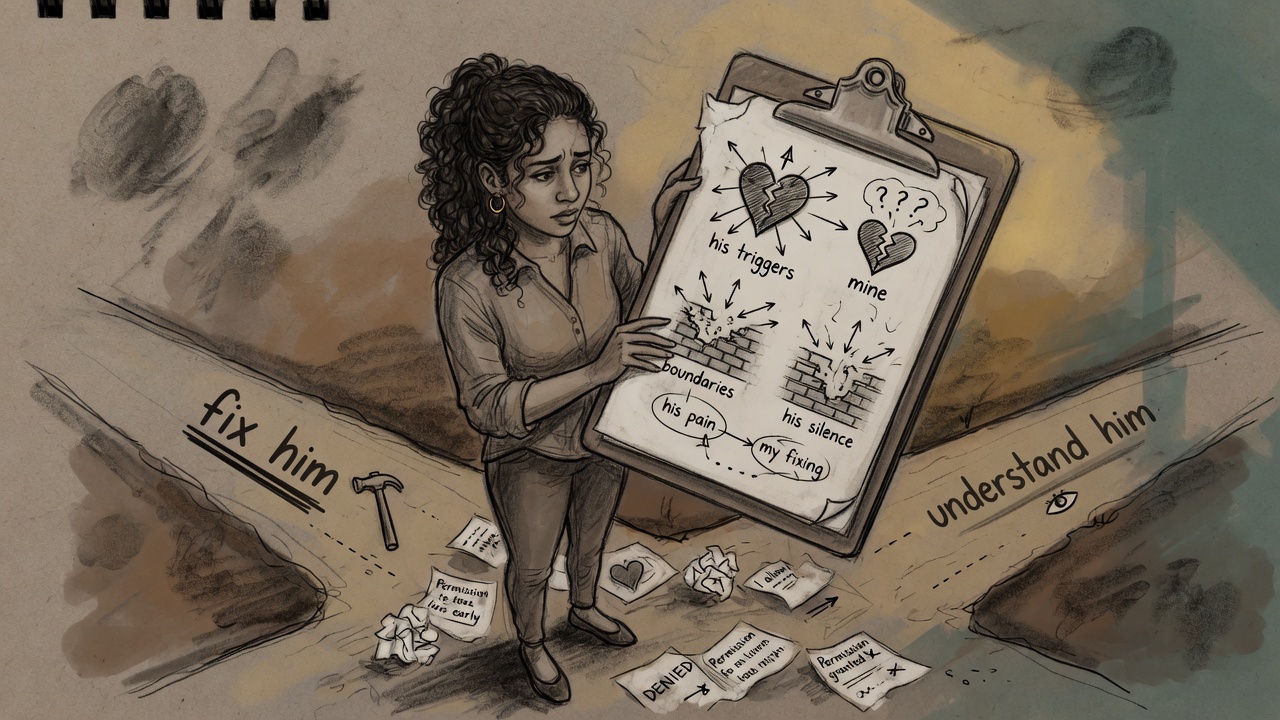
The permission slip was never the boy's to sign. It was ours.
Join the Conversation
Have a story about masculinity, identity, or what it means to be a man today? We want to hear it.
Share Your Story →